(5/9) Leachate pH (Macro- and Micro-Scale)
We recommend starting with the intro in Part 1 of this series.
pH is not a good quantitative indicator of CDR (even though it feels like it should be)
pH is often the first parameter people look at in weathering discussions. Intuitively, it makes sense: weathering consumes acidity and should raise pH.
But when we looked at the data, pH did not behave like a useful quantitative proxy for alkalinity export, at least not across the whole possible value spectrum.
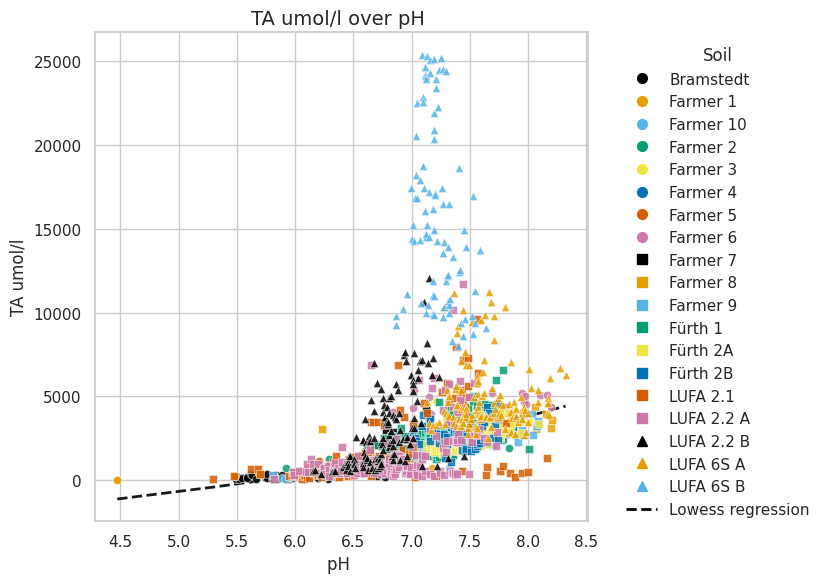
Figure 4: Relationship between pH and total alkalinity in 3,794 leachate samples (excluding disturbed phases). Dashed line: lowess regression for visualization.
At a glance, the scatter makes the point: Below pH 7 an increase of pH correlates with an increase in TA export. But above pH 7 you can have similar pH values with very different alkalinity, and high TA can occur without extreme pH.
As an additional side note, we observed something that surprises many people the first time they see it: Leachate pH ranges can be relatively independent of laboratory soil pH (measured in 0.01 M CaCl₂).
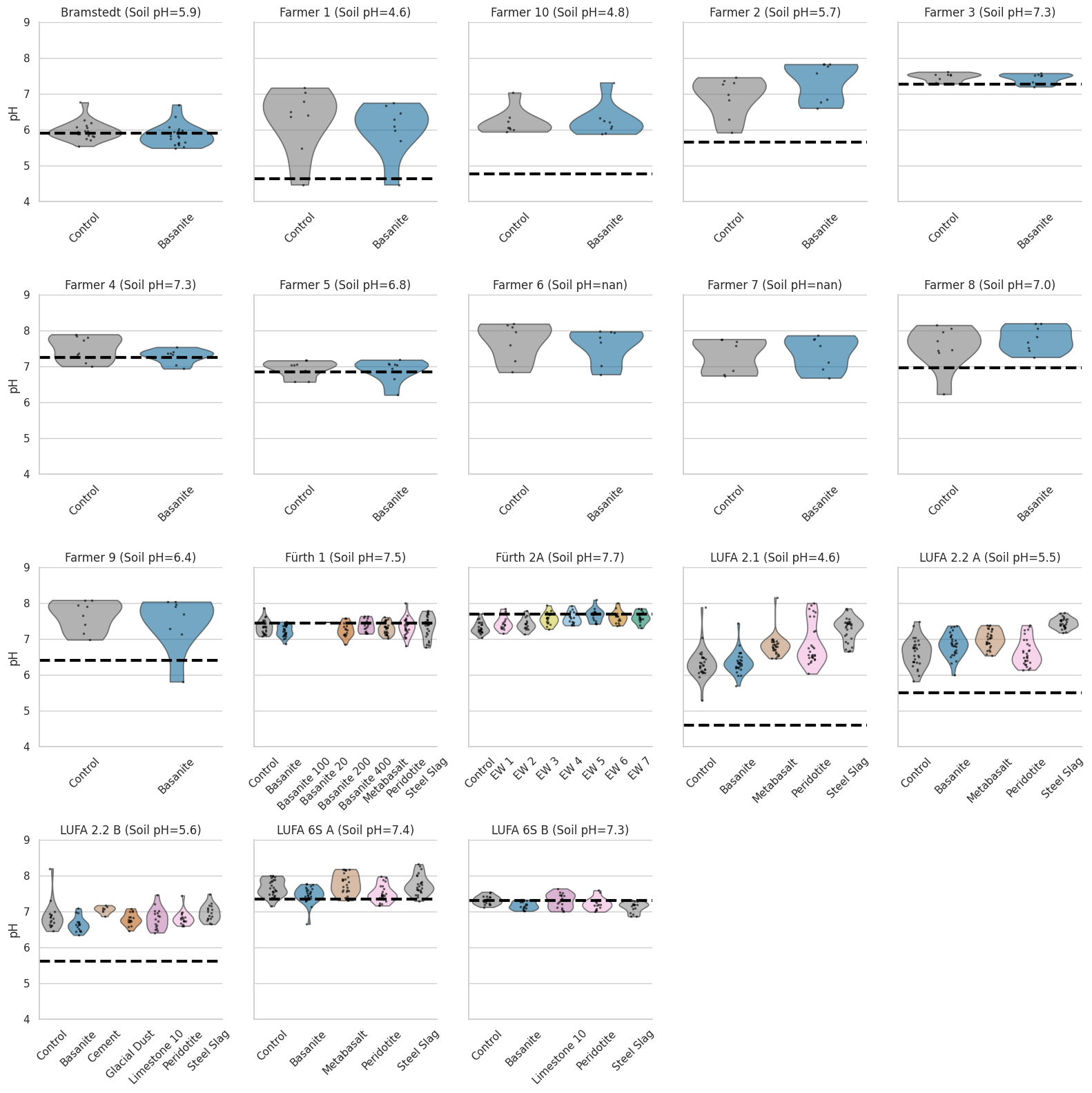
Figure 5: Violin plots of leachate pH for all soil/feedstock combinations across 12–36 months, alongside soil pH. The dashed line marks the soil’s pH (no soil pH data for Farmer 6 and 7).
Often, the leachate pH range is much higher than the soil’s measured pH, especially for low soil pH. The same visualization also shows that only a few treatments actually had higher pH than their controls.
Why pH disappoints as an MRV proxy
A big part of the problem is that pH is:
logarithmic (small numeric changes can reflect big shifts in H⁺ activity)
strongly buffered by soil processes
influenced by many reactions unrelated to EW-driven alkalinity export
not a flux metric (it doesn’t integrate export over time)
Carbon exists in different states across the pH range (see Bjerrum plot)
So while weathering can influence pH, and pH is chemically relevant for interpreting carbonate speciation, it does not track the TA signal in a way that is robust enough for quantifying CO₂ removal.
What this means for MRV of enhanced weathering in practice
Don’t try to “credit” EW from pH shifts
Our data support a simple rule: pH is not a quantitative indicator of CDR in this context.
pH can still be valuable for other reasons — risk monitoring, agronomic co-benefits, understanding carbonate system speciation — but it should not be treated as a direct substitute for alkalinity measurements.
pH remains important as a context variable
Even though pH is not a proxy for TA, it affects the interpretation of alkalinity in terms of bicarbonate vs carbonate contributions. In other words: pH is a parameter you want in MRV for chemistry integrity, not for crediting.
Read more…
MRV Proxies for EW? A Guided Tour Through Our Data From Our Two-Year Greenhouse Experiment
Part 2: Carbon Removal via Weathering and Treatment Variability
Part 3: Transient Disturbances: Initial Flush and Fertilizer Event
Part 7: EC’s Proxy Performance for Individual Treatments (Micro-Scale)
Download our scientific data report as PDF (Pre-Print)
Download the full PDF companion report (PDF, 4 MB, DOI https://doi.org/10.13140/RG.2.2.23232.39688) which is the reference backbone for the series. The data is available on Github https://github.com/dirkpaessler/carbdown_greenhouse_2023_2024 and via DOI https://doi.org/10.5281/zenodo.18360183.