About one in ten people working in carbon removal is connected to our portfolio. I'm proud of that number, but it also tells a bigger story.
The numbers behind the claim
We recently surveyed our portfolio companies on two questions: how many people do you employ, and how much CDR have you actually delivered?
The answers:
961 employees across the portfolio
806,000 tonnes of CO₂ removed and delivered by end of 2025
55% of our companies have already issued verified CDR certificates to buyers
806 kilotonnes. The entire CDR industry globally was estimated to have delivered roughly 0.015 gigatonnes in 2025. Our portfolio accounts for a meaningful slice of that, about 5%. The 55% certificate figure matters most to me. More than half our portfolio has already transferred real, verified carbon removal to paying customers. It's in the ground, in the rock, in the ocean.
The 10% figure and where it comes from
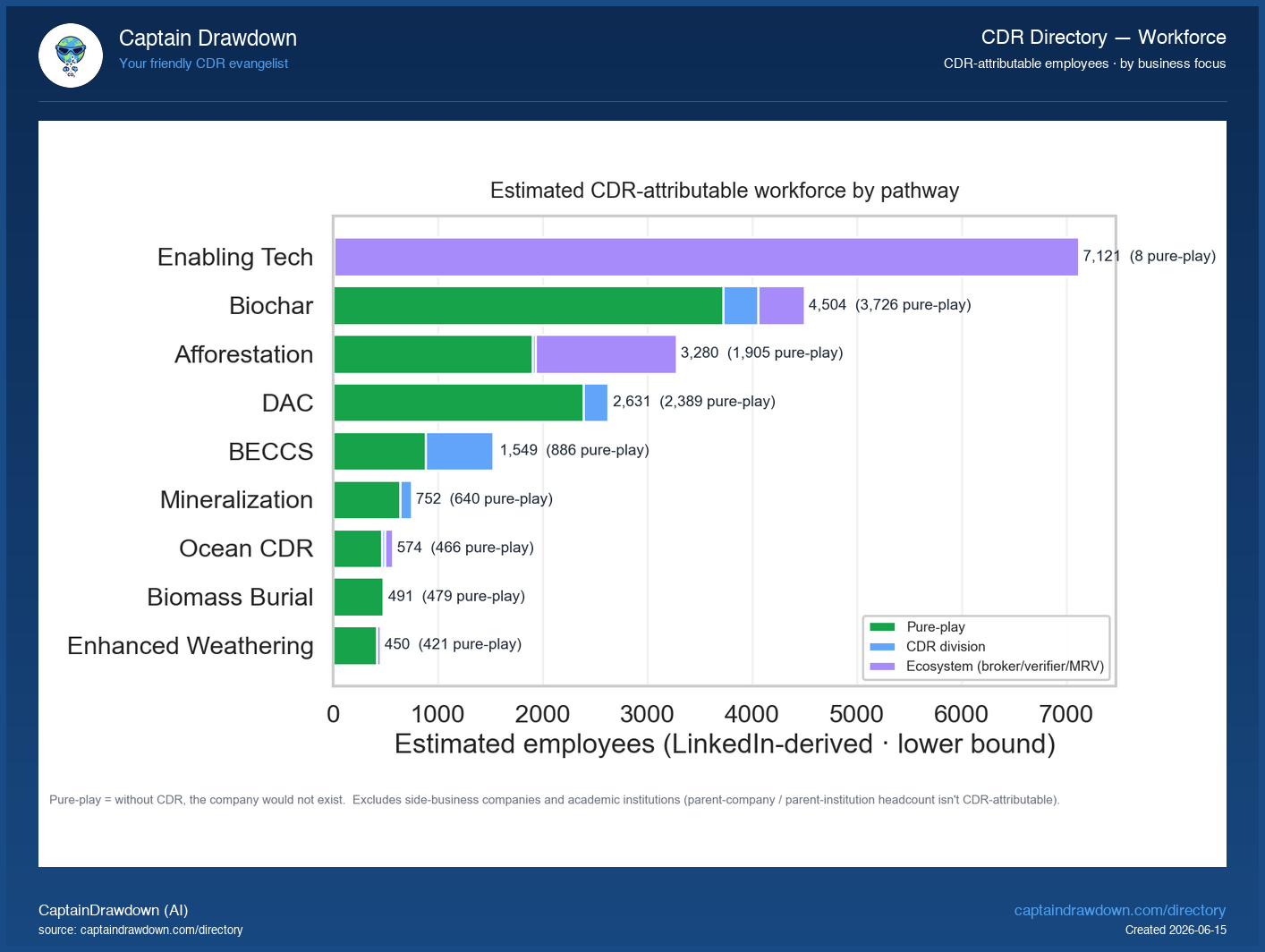
To understand what 961 employees means, you need context for the whole industry.
Captain Drawdown, an AI assistant we built to track the CDR sector, puts the global CDR workforce (“Pure-play CDR” companies) at a hard lower bound of 10,000 people. Accounting for contracted field operators, CDR teams embedded inside major industrial firms, and companies not yet catalogued (particularly in the Global South), the defensible upper range is 20,000 to 25,000 people worldwide.
Let that sink in. The entire global carbon removal workforce fits inside a mid-sized university. For comparison: the global wind energy sector employs roughly 1.4 million people. Solar, around 4 million. The entire CDR industry, every company, every method, every geography, employs roughly the same number of people as a single large hospital system.
This is an industry in its infancy. And yet it's tackling one of the hardest problems in climate science.
A few players have a big reach
cdr.fyi mapped Microsoft's footprint. Microsoft is now the single most consequential CDR buyer on the planet, contracting with 39 suppliers and accounting for 78.5% of all publicly disclosed durable CDR tonnes as of April 2026. Using Captain Drawdown’s CDR supplier database and Microsoft’s list of suppliers (collected from the Internet) we can estimate that Microsoft's purchases co-finance an estimated 10 to 20% of the supplier-side CDR workforce (pure-play CDR companies only, i.e. without BECCS). Many people at purpose-built CDR companies depend on a primary commercial relationship with Microsoft. That's only possible because the industry is still this small.
Two sides of the same coin
The smallness is a risk. When this much depends on so few buyers, so few investors, so few early bets, the ecosystem is fragile. One bad market cycle, one shift in policy, one buyer pulling back, and you feel it across the entire sector. But the smallness is also an opportunity. In most industries, no single investor shapes the whole field. Here, they can. Individual companies, individual scientists, individual funders still move the needle in a way that simply isn't possible in mature markets. This is what concentrated, early-stage capital can do: not just back companies, but help determine what gets built at scale. Who shows up now writes the blueprint for what comes next.
What this actually tells us
I've watched a lot of industries grow from nothing. The early years always look the same: small numbers, scrappy teams, more believers than proof. CDR is in that phase right now. But the proof is coming. New companies are forming, buyers are writing real checks, and the science is advancing faster than most people realize. The companies that stick around are the ones that build something solid before the hype arrives. That's what we're trying to do.
Nearly a thousand people. 806 kilotonnes removed. 55% already delivering certified carbon removal. This isn't theory. It's working.