CDR Portfolio
We help funding Early-Stage CDR Startups
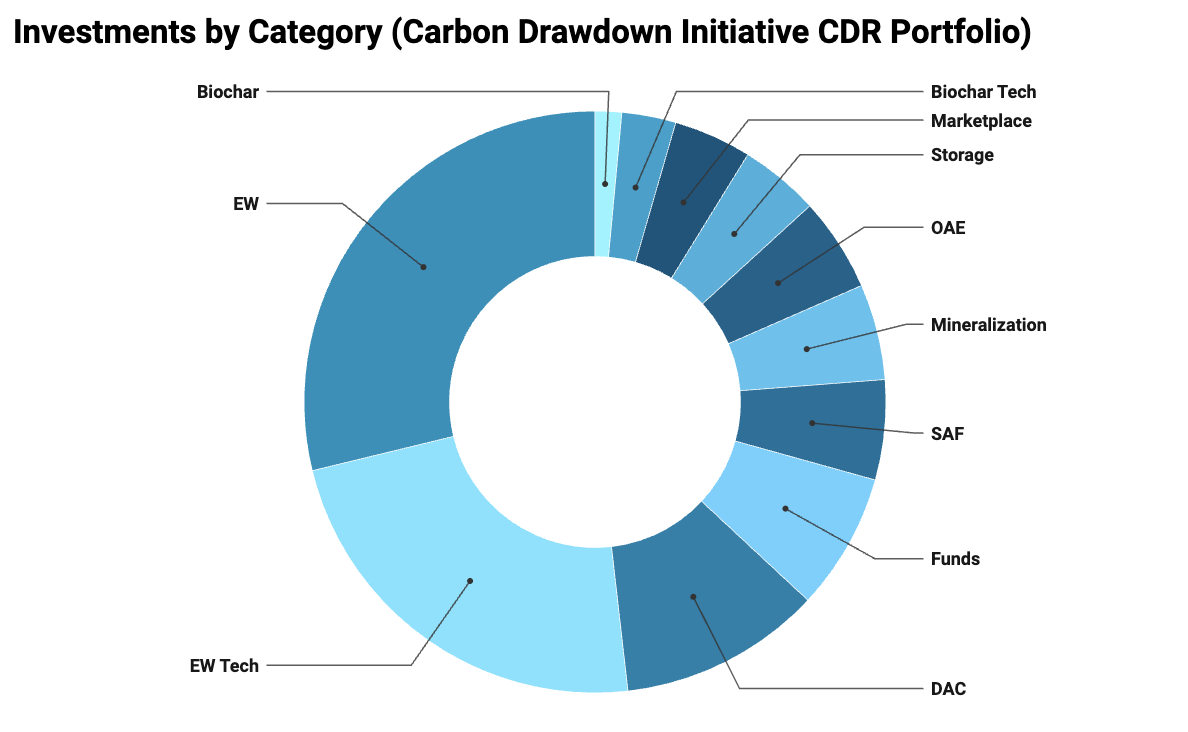
By providing capital to CDR startups at the angel-funding/pre-seed stage we are helping to find out, which CDR concepts will work and scale in the future. Currently most people think we will need a whole set of CDR methods to reach the necessary carbon removal amounts by mid-century. But for many methods the word is still out if they work and if they scale. Through these early-stage investments we bridge the critical gap until other, larger actors take on their necessary role. By doing so, we assume risks that few others are prepared to bear. Our goal is to advance the science, technology, and organizations essential for the carbon dioxide removal (CDR) industry as early as possible.
One of the most important insights for each method is: How far can we get with it. Because when we find out that an idea doesn’t work, then we need to know as early as possibe and then we need to double down in the remaining ideas!
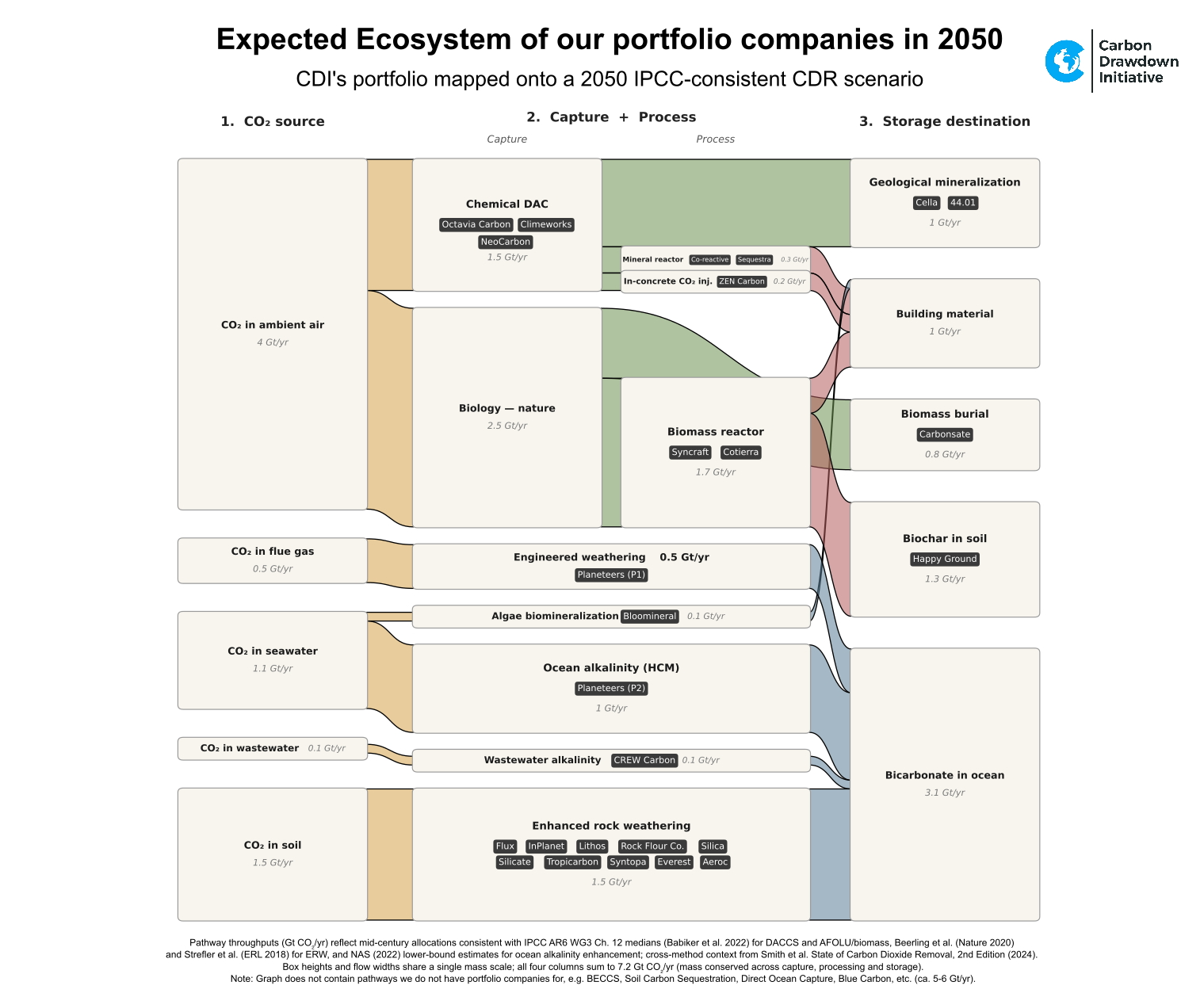
The following visualization shows - based on expected/estimated 2050 global CO₂ fluxes - what pathways exist and where our portfolio companies have set their focus on. Note, this chart does not contain all possible pathways, e.g. BECCS and forestation are missing. The whole graphics is explained in our blog.
Our CDR Portfolio
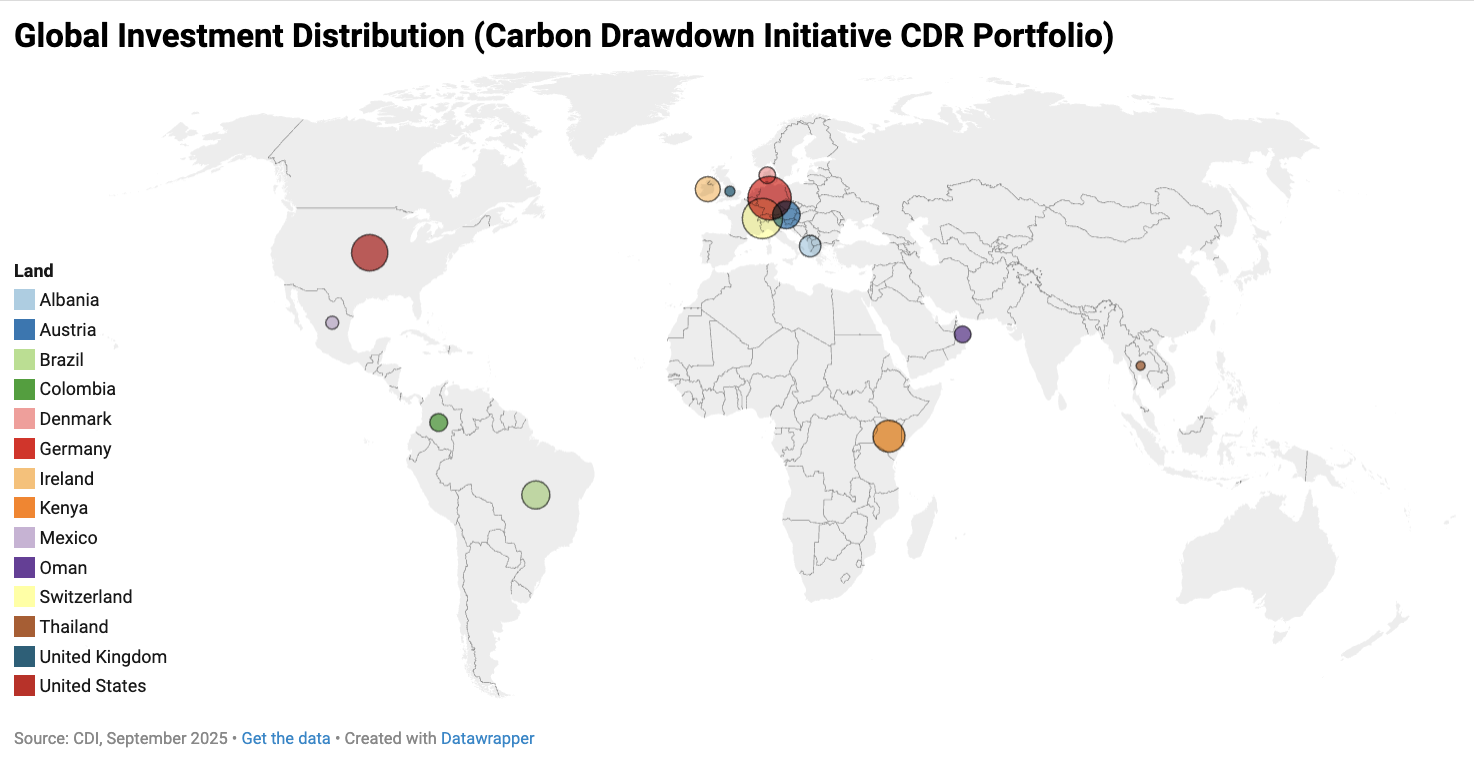
Since 2020 we have invested in more than 30 companies with more than 700 employees (end of 2024), here are some of them:
| Company Name | Employees (end of 2024) |
What They Do | Region(s) of Activity |
|---|---|---|---|
| 4401 | 65 | Underground carbon storage | Oman, UAE |
| Aeroc | MRV Infrastructure for EW | Globally | |
| Altitude Carbon | 5 | Carbon negative aviation fuel | Globally |
| Bloomineral | Mineralization | France | |
| Carbonfuture | 40 | Digital Monitoring, Reporting, Verification & Marketplace Infrastructure | Globally |
| Carbonsate | Biomass burial | Namibia/Africa | |
| Cella Mineral Storage | Underground carbon storage | Kenya | |
| Climeworks | 480 | Direct Air Capture (DAC) | Switzerland, Germany, Iceland, USA |
| Co-reactive | — | Enhanced Weathering (EW) | Europe |
| Cotierra | — | Biochar | Latin America |
| CREW Carbon | 10 | Carbon mineralization in water treatment plants | USA, Europe |
| Eion | 15 | Enhanced Weathering (EW), acquired by Terradot | USA |
| Everest Carbon | — | Monitoring for Enhanced Weathering (EW) | USA, EU, India |
| Flux | 15 | Enhanced Weathering (EW) | Africa (HQ in Kenya) |
| Happy Ground | — | Biochar | Asia (Thailand) |
| InPlanet | 38 | Enhanced Weathering (EW) | Brazil |
| Lithos Carbon | 25 | Enhanced Weathering (EW) | North America |
| Planeteers | 15 | Carbon mineralization in water treatment plants | Germany |
| Octavia | 60 | Direct Air Capture (DAC) | Kenya |
| Rock Flour Company | — | Glacial dust for EW | Greenland |
| Sequestra | — | Carbon storage with industrial waste materials | Austria |
| Silica | — | Enhanced Weathering (EW) | Mexico |
| Silicate | 10 | Enhanced Weathering (EW) | Ireland, USA |
| Subtidal | 4 | Monitoring for marine CDR (mCDR) | North America, Europe |
| SYNCRAFT | Reverse power plants, biochar | Austria | |
| Syntopa | 7 | Bacteria-based acceleration of Enhanced Weathering (EW) | North America |
| Tropicarbon | 10 | Enhanced Weathering (EW) | Colombia |
| ZEN Carbon | CO2 storage in concrete | kenya |
Our non-ERW CDR portfolio companies grouped by technology focus
Direct Air Capture — capture-focused, storage handled separately
NeoCarbon
CO₂: ambient air (DAC)
Energy: waste heat from data centers and cooling towers
Output is a captured CO₂ stream; needs partner storage downstream (e.g., Cella, 44.01).
Octavia Carbon
CO₂: ambient air (DAC)
Energy: Kenyan geothermal and waste heat
Africa's first DAC; storage co-located in Kenyan basalt (Cella partnership).
Climeworks
CO₂: ambient air (DAC)
Energy: Icelandic geothermal (Orca, Mammoth)
Swiss DAC pioneer; storage in Icelandic basalt via CarbFix (external partner).
Geological storage — agnostic to CO₂ source
Cella
CO₂: any captured stream (DAC partners)
Inputs: basalt formations (Kenyan rift), water
Underground injection; in-situ mineralization to stable carbonates over months to years.
44.01
CO₂: any captured stream (industry or DAC)
Inputs: mafic/ultramafic rock (peridotite, basalt), seawater or wastewater
Dissolves CO₂ in water and injects deep underground; mineralizes within 12 months.
Stored in concrete & building materials
Bloomineral
CO₂: atmosphere, fixed by calcifying algae
Inputs: seawater, alkaline cement waste (CKD)
Macroalgae produce ultra-pure aragonite (PCC) sold as cement filler and substitute.
Co-reactive
CO₂: any source (point, biogas, DAC, pipeline)
Inputs: olivine plus metallurgical residues
Tubular high-pressure reactor producing CO-SCM, a pozzolanic cement substitute (~330 kg CO₂/t).
Sequestra
CO₂: any industrial or biogenic stream
Inputs: steel slag, biomass ash, demolition waste
Modular ACT containers deployed on-site at the residue producer.
ZEN Carbon
CO₂: DAC partners (e.g., Octavia)
Inputs: wet concrete during mixing
In-situ injection at concrete plants forms nano-CaCO₃ inside the concrete itself.
Stored in water/ocean as bicarbonate
Planeteers
Path 1: point-source CO₂ + limestone/water → bicarbonate via closed engineered-weathering reactor
Path 2: atmospheric CO₂ + ikaite (HCM tech) released to the ocean → alkalinity enhancement
CREW Carbon
CO₂: wastewater biological streams
Inputs: calcium carbonate (limestone)
Alkalinity dosing inside wastewater treatment plants; bicarbonate flows out in the effluent.
Biomass burial & biochar — biological capture, solid storage
Carbonsate
CO₂: atmosphere, fixed by trees (photosynthesis)
Inputs: forest biomass; underground burial sites (Namibia, Cameroon, Colombia)
Biomass burial. Whole biomass stored anaerobically underground to prevent decomposition; 100+ year durability claimed (Puro-certified).
Syncraft
CO₂: atmosphere, fixed by trees (photosynthesis)
Inputs: forest residue wood (woodchips)
Biochar via gasification (Reversepowerplant). 40+ plants deployed; biochar applied as soil amendment, concrete additive, or fossil-coke substitute in metallurgy.
Cotierra
CO₂: atmosphere, fixed by coffee plants
Inputs: coffee residues at farm sites
Biochar via decentralized on-farm reactors; biochar applied to soil. Co-benefit: improved smallholder farmer margins, supply-chain resilience.
Happy Ground
CO₂: atmosphere, fixed by rice and oil palm
Inputs: agricultural residues (rice, oil palm) — alternative to open burning
Biochar-enhanced fertilizers (BEF) for Thai smallholder farms. SBTi/ISO-aligned MRV. Co-benefit: PM2.5 reduction, N₂O reduction.