A guest post by our intern, Tina vom Hagen
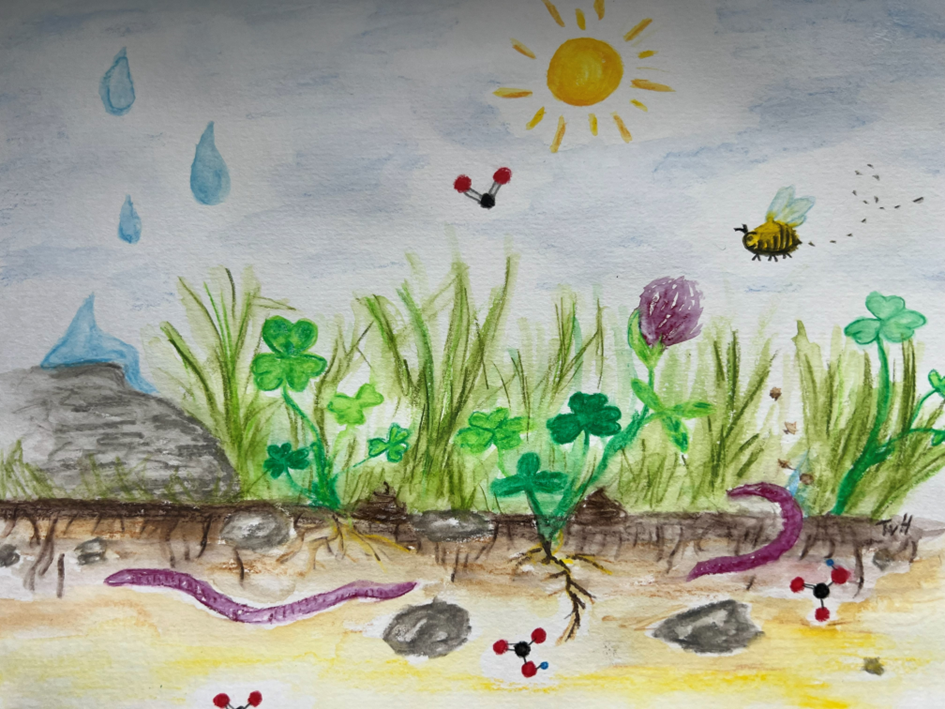
I remember the first time I heard about climate change at school. It has influenced me ever since. Learning that it is human-induced and unavoidable was both frustrating and worrying. However, I also remember that at first, I could not believe that climate change really existed. The reason for this was that I would have expected to have learnt about it earlier. If the world was about to 'die', I would have expected it to be the number one topic because people would be doing everything to prevent it. Nevertheless, I had to recognise that most people seem to accept the situation and continue living their lives as usual. At least I have started doing my very best to reduce my personal footprint. But why aren't most people and politicians joining in? We are running out of time, and I began to lose hope that we can reduce climate change.
But then, a few years ago, I watched the documentary “Kiss the Ground”, directed by Joshua Tickell and Rebecca Harrell Tickell. It was the first time I had ever learnt about carbon capture and storage via bio sequestration. The fact that there is a way to reduce the concentration of CO₂ in the atmosphere gave me hope. It was a hope I had not had before. I realised that we could not only reduce global warming, but even reverse it by offsetting past emissions and those that are hard to abate, e.g. such as those from water treatment plants, shipping or steel industry. The idea of negative emissions fascinated me so much that it manifested my dream of studying sustainable agriculture.
When I talked to my former boss about my plan and intentions, I learned about the Carbon Drawdown Initiative, which aims to achieve negative emissions through enhanced rock weathering. He offered to put me in touch with his friend who works there. Now I am here at the CDI and wrapping up my two-month internship. Through this experience, I have realised that enhanced rock weathering is more complex than the underlying geochemical processes alone.
In general, ERW offers huge potential for negative emissions. Natural silicate weathering is considered a very stable geochemical process for long-term carbon sequestration in oceans and soils, and ERW aims to accelerate this process. But not just that, the application of rock dust could bring positive side-effects for agriculture like reduced uses of fertilizer, increased yields, higher crop quality and resilience of the plants.
What I really like about the idea of using rock weathering as a natural process is that we already have all the tools we need to put it into practice and that you can use agricultural areas for dual purposes. You can in principle rely on natural processes with a lower risk of facing new unknown consequences, which sometimes happens with new technologies. However, getting deeper into the CDR topic reveals that it is not as easy as expected to understand all processes. There are many different interactions between soil, feedstock, surroundings, and livestock for ERW, which make its direct implementation more difficult.
So far, it is not clear which feedstock each soil responds best to in terms of ERW for CDR. The current state of research in this field is that the ERW community is still learning about the optimal conditions and underlying principles for maximising carbon sequestration and developing guidelines. In addition, some rock dusts have the potential to improve soil quality and plant growth, for example by raising the pH level and providing mineral nutrients. Here it is important to consider the maximum amount of rock you add to the soil for enhancing the process of ERW while not doing harm to the soil system. By adding large amounts of rock dust to soils you want to make sure not to change the soil too drastically in a negative way and overshoot dosage limits regarding different nutritions and heavy metals. For this reason, care must be taken to ensure that any deployment complies with regional guidelines, to guarantee that it does not result in any danger or long-term environmental damage.
Another important key challenge for ERW is to make it more attractive and affordable by improving MRV strategies. Accessing finely-ground rocks, spreading it on fields and measuring the CDR by ERW requires costly infrastructure and labour. In particular, the irregularities in the soil make it still difficult to identify an universal parameter that can be used to calculate the amount of stored carbon in an easy and cheap way. For scaling up the sector, affordable CO₂ certificates are urgently needed but without funding and policy guidelines this will be challenging.
However, we must first solve the aforementioned issues before we can realise all its benefits. Most of the environmental concerns can be managed, such as high concentrations of heavy metals, by ensuring compliance with threshold limits. The largest real uncertainty is the associated costs of MRV, which may not allow ERW to be a commercially viable climate solution for helping to achieve net-zero emissions. This is why more research in this field is needed! We need scientists to work out how to measure ERW cheaply, establish when it is most effective and prove how it can be made safe for the environment. Then, we need people — especially farmers — to apply rock dust to their land. Throughout this process, we need policies that support them.
I really admire the CDIs' patience and endurance. They tirelessly explore new ideas to solve the puzzle! Thank you for all your efforts! I am sure the breakthrough will come. In the meantime, I am going to study agriculture in order to learn more about the miracles of the soil and its interactions within the ecosystem. My internship showed me that there is still much to discover, and confirmed that this is the subject I want to study.
Dear reader, please do your bit to fight global warming!
We thank Tina for her valuable help in spring 2026 and for sharing her thoughts here!