400 Pots, Three Years, and the Results Are (Almost) In
On June 16 and 17, 2026, we are hosting the Carbon Drawdown Symposium in Erlangen, Germany. We invited fifty researchers and practitioners from across the Enhanced Rock Weathering (ERW) community to come together and look at a single dataset: what three years of greenhouse experiments across 400 lysimeter pots have actually produced, once independent labs have had their hands on the samples.
This Symposium (the presentations of which will be streamed online for free) closes a process that started in September 2025, when we put out a call for proposals offering grant-supported access to more than 1,000 soil and biomass samples from our GH2023 greenhouse experiments. The response was stronger than we expected, and we selected a set of proposals that together cover the full picture: from soil geochemistry and cation pools to biomass nutrients, trace metals, and three independent approaches to soil organic carbon. The collaborators of those proposals are the presenters on Day 1.
Why makes this dataset so unique
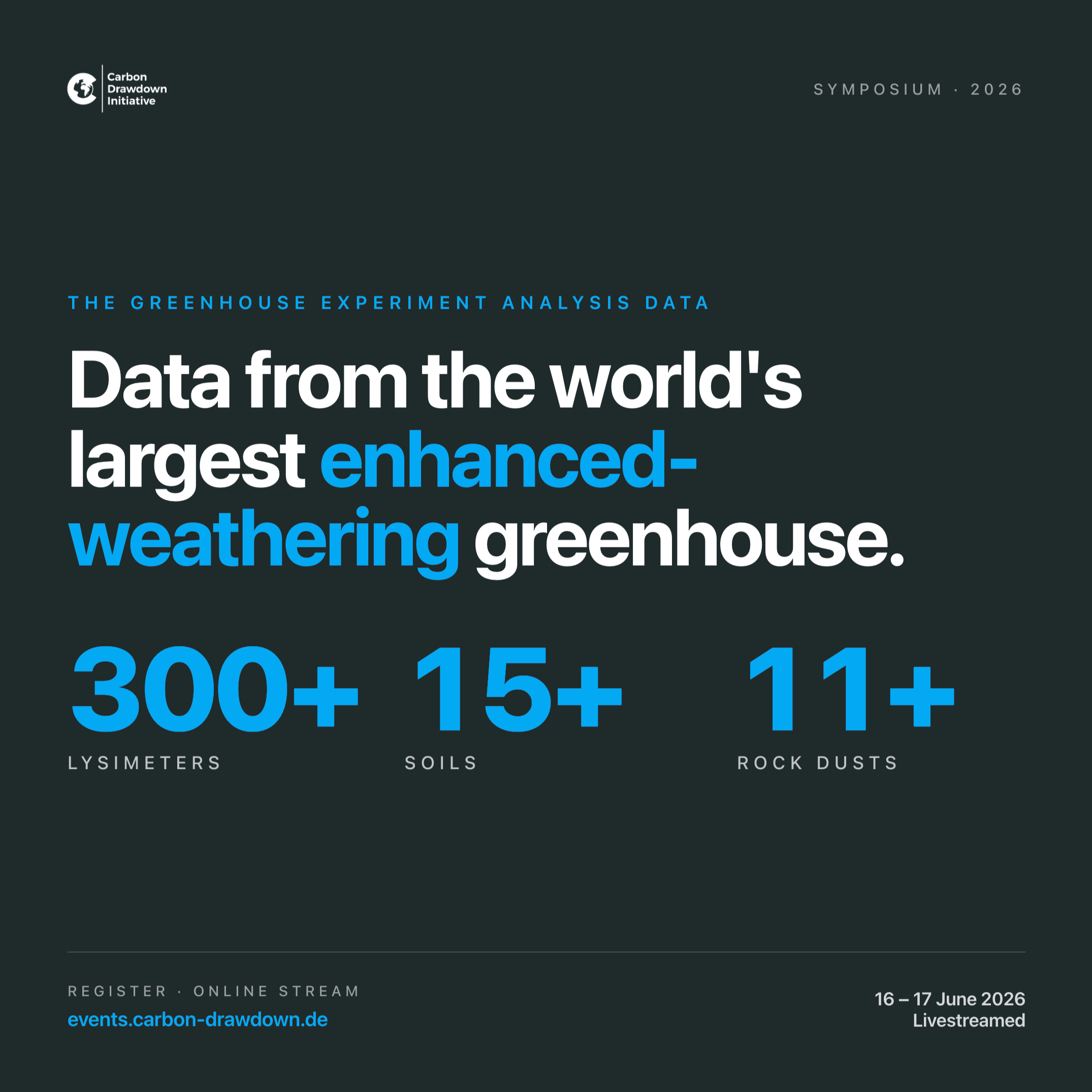
There are, as far as we know, very few (if any) ERW experiments that have monitored this many rock × soil combinations over this long a time - up to three years - and then sampled and analysed the post-experiment soil this thoroughly. With roughly 400 lysimeter pots, continuous leachate chemistry throughout, and systematic sampling at dismantling, we expect to have a pretty complete picture of what happened inside each pot. We believe that is ambitious territory for ERW science, and that is the reason we built the largest ERW greenhouse experiment in the world in the first place: to answer questions that field trials alone cannot answer on a realistic timescale.
The catch is that a complete picture of carbon dioxide removal (CDR) through ERW might not match the image we anticipated. That is exactly why we designed the Symposium the way we did.
Day 1: Results - Tuesday, June 16 (Free Online Access!)
Single track, all day. Speakers present analytical results back-to-back in four thematic blocks, with a shared Q&A at the end of each.
Session 1: Policy, MRV, the CDI experiments and dive into general soil chemistry.
Dirk Paessler (CEO and host) welcomes the audience.
Chris Sherwood (Negative Emissions Platform) sets the scene clarifying why ERW is not yet included in EU’s carbon removal policy and emission trading system (EU ETS),.
Christoph Beutler (Carbon Gap) gives a snapshot of carbon removal quantification through monitoring, reporting and verification (MRV) practiced at ERW companies today.
Jens Hammes (CDI) walks through CDI's experimental design and the total-alkalinity results from up to three years of soil water leachate collection.
Mike Kelland (University of Sheffield) and Paul Nelson (James Cook University) present end-of-experiment soil characterisation (pH, pH buffering capacity, CEC, exchangeable Ca/Mg/Na/K, SIC, SOC, total N) with the goal of closing the cation and carbon mass balances and explaining why aqueous-phase CDR estimates have been lower than expected.
Session 2: Where in the soil did the cations end up?
Lucilla Boito (University of Antwerp) uses Tessier-type sequential extraction to differentiate between cations in the exchangeable, carbonate-bound, reducible and clay-associated soil pools. This method aims at resolving where the cations released from rock dissolution that did not end up in the leachate water actually ended up.
Philip Pogge von Strandmann (Johannes Gutenberg-Universität Mainz) combines bulk-soil high-precision TiCAT/SOMBA analyses with CEC-leachate ICP cation measurements to distinguish primary dissolution and secondary mineral formation, backed up by targeted Li isotopes for mechanistic confirmation.
Session 3: Biomass response to ERW.
Xavier Dupla (ETH Zürich) reports on how basalt, peridotite and concrete feedstocks at 40 t/ha application affect soil chemistry, plant nutrient status and forage quality in ryegrass, investigating the effect of ERW including the heavy-metal side of the story.
Mathilde Hagens (Antwerpen University) links dry biomass production to plant Mg/Ca/Na/K/P uptake across 4 different soils treated with the same 4 feedstocks (steel slag, peridotite, metabasalt, basanite). She also analyses Ni and Cr by ICP-MS to track trace-metal transfer into plant tissues.
Benjamin Möller (ETH Zürich) investigates whether ERW can enhance the phytolith-occluded carbon sink, a durable organic-carbon pool (200 to 1,000+ years) that is increased through silicon fertilisation but is so far often overlooked in ERW accounting.
Session 4: Soil organic carbon (SOC) - three methods, one question.
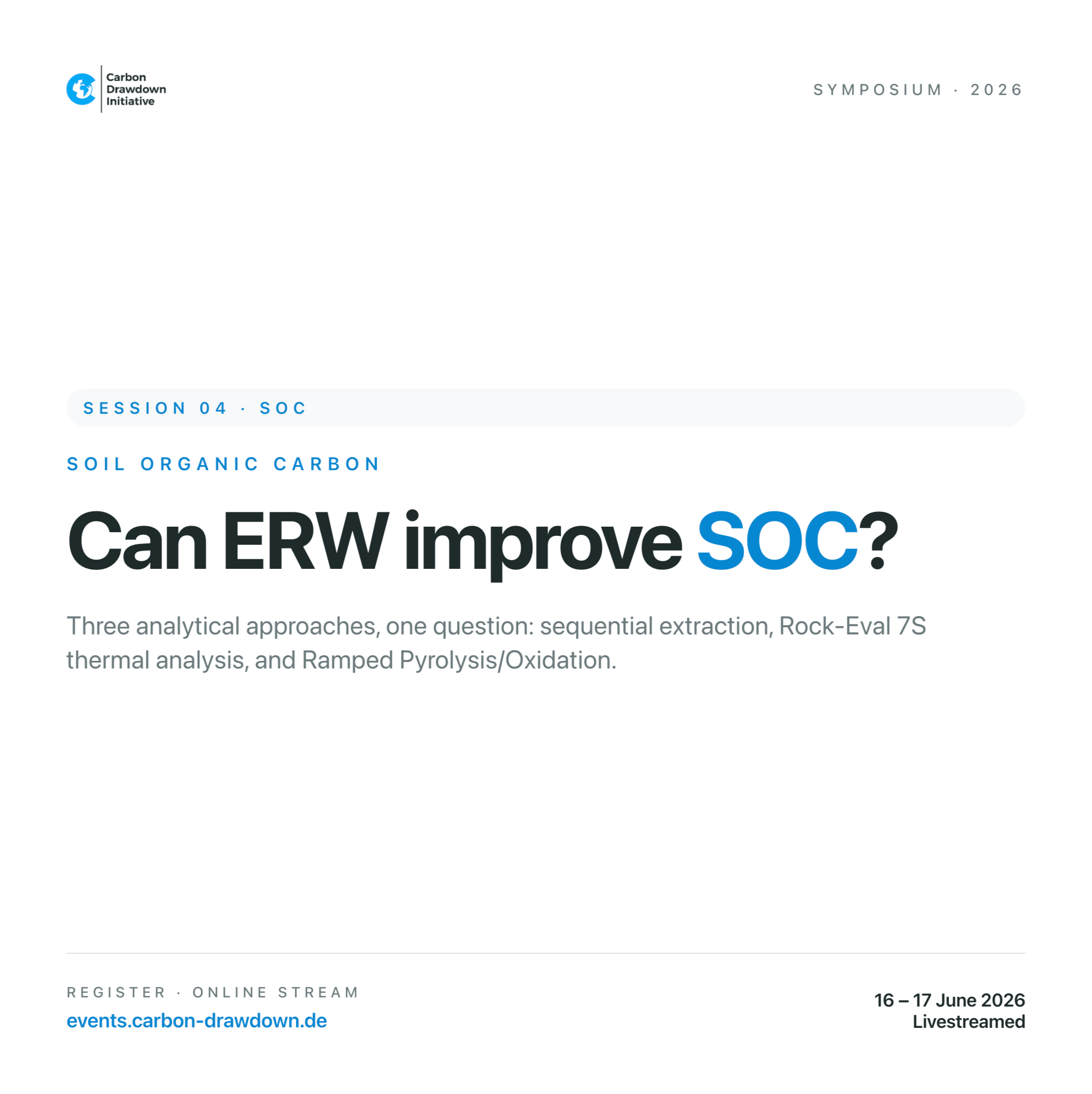
Can ERW actually increase the stability of SOC through the formation of more mineral-associated organic matter (MAOM)? Three independent teams tackle the same question through different analytical approaches carried out on the same material:
Lucilla Boito (University of Antwerp)applied sequential extraction following Heckmann et al. (2018) and Steinwidder et al. (2025) prior to SOC measurements.
Mathilde Hagens (Wageningen University & Research) carried out Rock-Eval 7S thermal analysis leading to ~40 diagnostic indices per sample.
Manuel Ruben and Malte Hoehn (Alfred-Wegener-Institute) used Ramped Pyrolysis/Oxidation to look at the thermal stability of the organic pool.
How well the three answers line up (or do not) will be one of the more interesting moments of the day.
Wrap-up. Jens Hammes offers a sneak peek of our next, already set-up and running, CDI greenhouse experiment (now with 450 pots!), and Patrick Niedermayer explains the format of the Day 2 workshops.
The full agenda and speaker details are on the event page.
Day 2: Bar Camp - Wednesday, June 17
The 50 attendees re-convene on-site for a participatory workshop-event in the form of a bar camp. There is, deliberately, no preset agenda - the attendees collaboratively build the day’s focus and program in the first 30 minutes together. The workshop sessions on Day 2 thereby emerge from the questions the attendees will bring in. That is the whole point.
We specifically chose the bar-camp format because we are fairly sure some of the Day 1 results will be surprising. Possibly contradicting our own working assumptions. Possibly contradicting each other. Almost certainly contradicting some results of published scientific literature. When that happens, the least useful thing for 50 experts physically present in the same room to do is to sit through another round of lectures. So instead, we make time and space for them to talk to each other, challenge the interpretations, and figure out which downstream questions are worth pursuing next.
Day 1 is open to everyone online
On-site attendance is invitation-only, and the 50 seats are filled. But anyone can follow Day 1 remotely: the live stream is free to register for on the event page. If you care about ERW MRV, about cation budgets versus carbon budgets, about how soil organic carbon actually responds to silicate amendments, or about what 400 well-sampled pots can and cannot settle: tune in!
What we hope to come out of this event
Honestly, we don’t exactly know - which is why we are running a symposium this way rather than writing a single summary paper and calling it a day.
What we expect: some of our own assumptions about leachate-based MRV will hold up, some will not, and several of the presenting teams will find insights in the data that we have not noticed ourselves. What the community does with those findings - how they define new research questions and focus, flow into methodology andMRV standards, ERW company practice, and eventually policy - is to be seen, but will likely be directed in part by the 50 invited in person attendees which represent the entire community
For us at CDI, this Symposium is also a checkpoint on a much longer question: how much of the climate-crisis solution space can enhanced rock weathering realistically cover, and under what conditions? We do not yet have an answer we are fully confident in. But after June 17 we will have a better picture of where the remaining uncertainty lies - and that matters at least as much.
See you online on June 16, and safe travels to those making the trip to Erlangen!