One year later... and buying CDR certificates is still hard
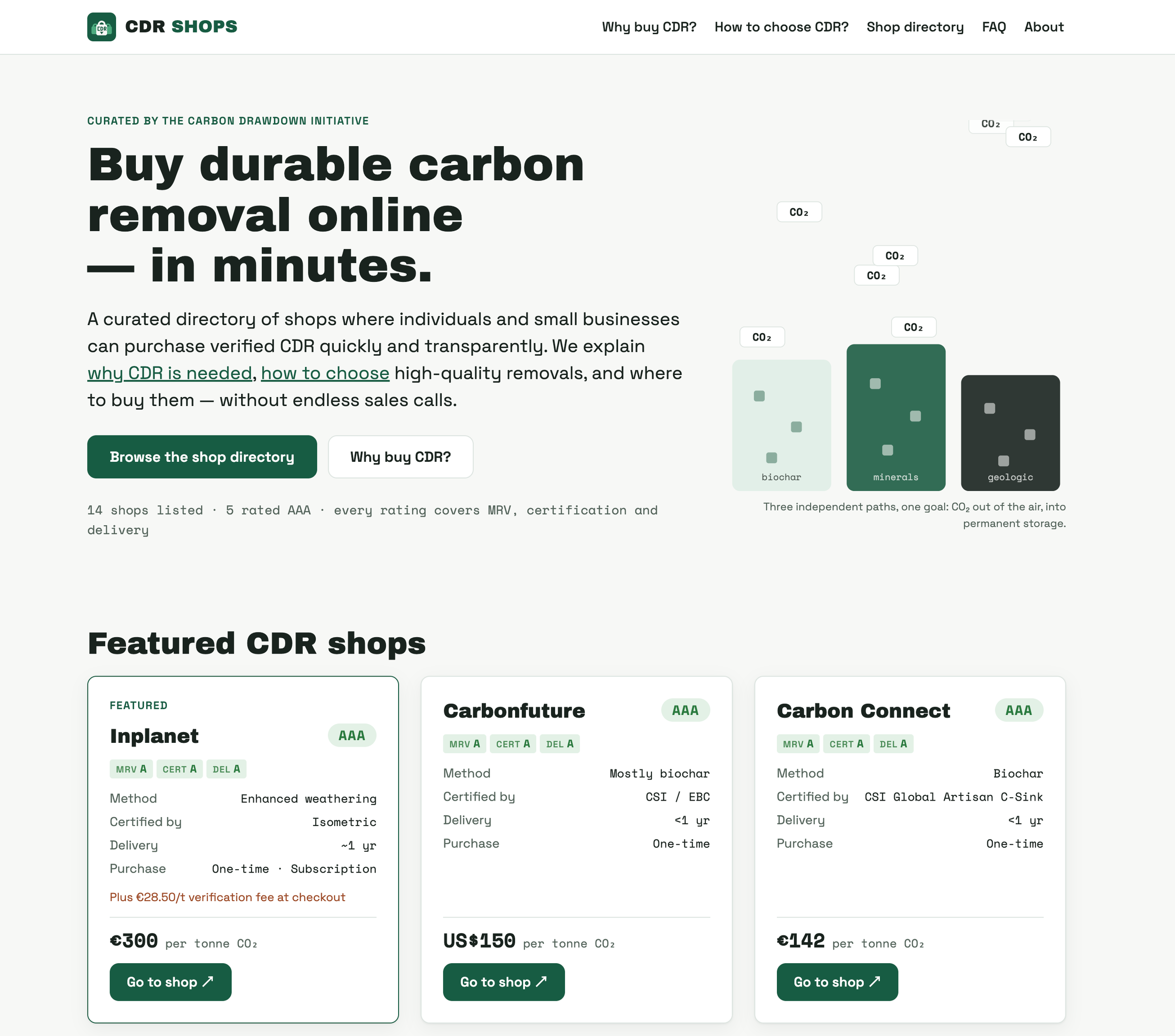
A year ago we tried to buy 200 tonnes of CDR to balance our own GHG emissions and found out that almost nobody would sell to us without a sales call. We built a small directory of the shops that would — that story is here. This month we rebuilt that directory from scratch, and this time we did not browse. Captain Drawdown, our AI agent, enumerated the market: every supplier on the Isometric registry (60 suppliers, 78 projects), every supplier on Puro.earth (70 suppliers, 119 projects), every durable-CDR project on Rainbow (51 suppliers), plus the 566 reachable supplier websites in Captain's own database of 1,814 CDR companies. Checkout pages, embedded payment widgets, storefront platforms, "buy" buttons hidden three clicks deep — if a company sells removal online, this sweep would have found it.
It found 14.
Fourteen shops, out of roughly 650 companies checked, where an individual can buy a few tonnes of durable, independently certified carbon removal with a credit card, today. That is 2 in 100. At the other 98 you will get a demo, a quote form, a "talk to our team" button, or — our favorite — a storefront that technically exists but requires an access code to see the buy button. This is an industry that spends every conference panel complaining about missing demand, and then locks its front door.
The 14 are not even the same 14
Three of last year's shops quietly stopped selling within twelve months: one vendor's purchase page simply vanished, one switched to contact-only, one webshop was shut down entirely. Three came in new. And one of the three new entries is not a supplier at all but a reseller — Remove Carbon Today, a founder-funded one-person shop from Finland that buys certified CORCs and retires them in your name within a month, because selling one tonne to one person is apparently a job the industry itself won't do.
When the best retail experience in a market is run by a volunteer-scale middleman, that tells you something about where the gap is: the unit economics of small sales (verification fees, payment fees, support) scare suppliers off, and the aggregator layer that should absorb them barely exists.
We even tried to buy the industry its customers
Before anyone answers "there just isn't any retail demand": we tested that, with money. In late 2025/early 2026 we spent about €8,700 on Facebook and Instagram ads pointing at this directory. Two months of ads bought 11,300 visitors at €0.76 each, and the directory passed 276 of them — 2.4% — straight to a CDR shop's door, at an effective €31.50 per delivered shop visitor. Under conservative assumptions that is a customer acquisition cost of roughly €315, a number plenty of subscription businesses pay happily.
Demand can be bought at ordinary ad-market prices. It is the supply side that answers the doorbell with a contact form.
What a year of traffic actually looks like
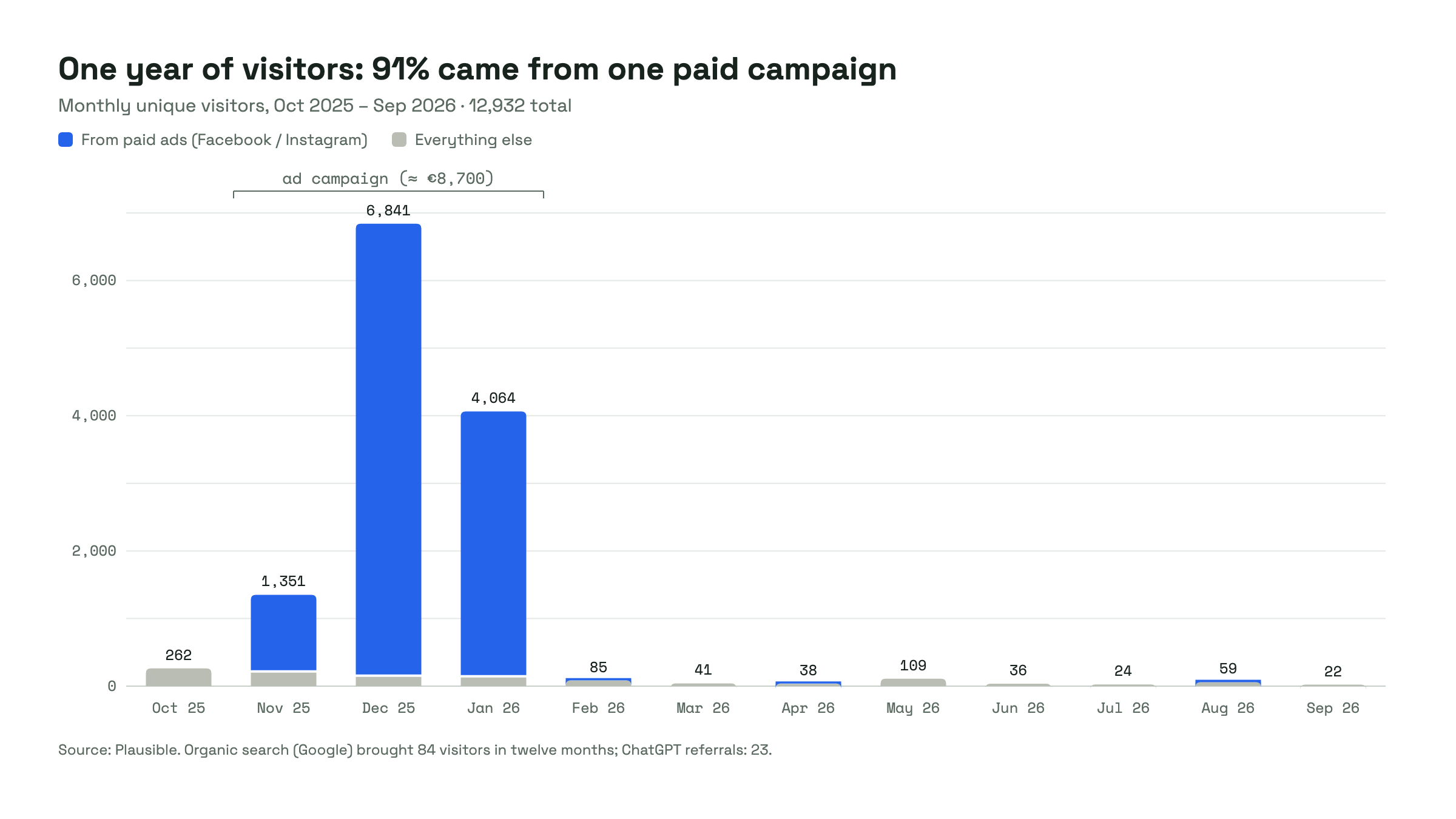
The full twelve months: 12,932 unique visitors, of which 91% came from that one paid campaign. After the ads stopped, the site settled at 22–109 visitors per month. Organic Google search delivered 84 visitors in an entire year — nobody types "buy carbon removal" into a search engine, because nobody expects it to be buyable. The one organic channel that did show up unprompted: AI assistants, with 23 referrals from ChatGPT alone. Vendors have started writing to us because "AI models are increasingly citing your site." Being purchasable online is quietly becoming the precondition for existing in AI-mediated buying advice. Companies without a checkout will not just lose the sale; they will not even be mentioned.
No shops means no prices
Across the 14 working checkouts, a tonne of durable CDR costs between €142 and US$1,000 — a 7x spread that nobody can arbitrage, because you cannot comparison-shop what you cannot buy. Price discovery for small buyers simply does not happen in this market. Case in point: our top-rated vendor cut its price from €400 to €300 per tonne this year, a 25% drop, and as far as we can tell nobody noticed. There was nowhere to notice it.
The fix is one widget away
Here is the uncomfortable part: the hard infrastructure already exists. Isometric ships an embeddable Stripe checkout; three of our 14 shops are exactly that widget — Inplanet, Planeteers and NULIFE all sell through it. If Isometric, Puro and Rainbow gave every validated supplier a "sell one tonne online" switch, the number of real CDR shops could grow tenfold overnight, with certification and retirement handled where they belong — in the registry. Until then, carbon removal remains un-amazonified: no one-click buying, hardly any visible prices, and a market that keeps asking where the buyers are while standing behind a locked door.
The rebuilt directory is live at cdr-shops.com: 14 shops, each rated A–C on MRV, certification and delivery, every link and price checked continuously by Captain Drawdown. If you run a CDR company and we missed your working checkout, one email gets you listed, free. If you run a CDR company and you don't have a checkout: it is the cheapest demand-side intervention you will ever build.