New preprint: Can crop yield increases be an early signal for CO₂ removal in enhanced weathering?
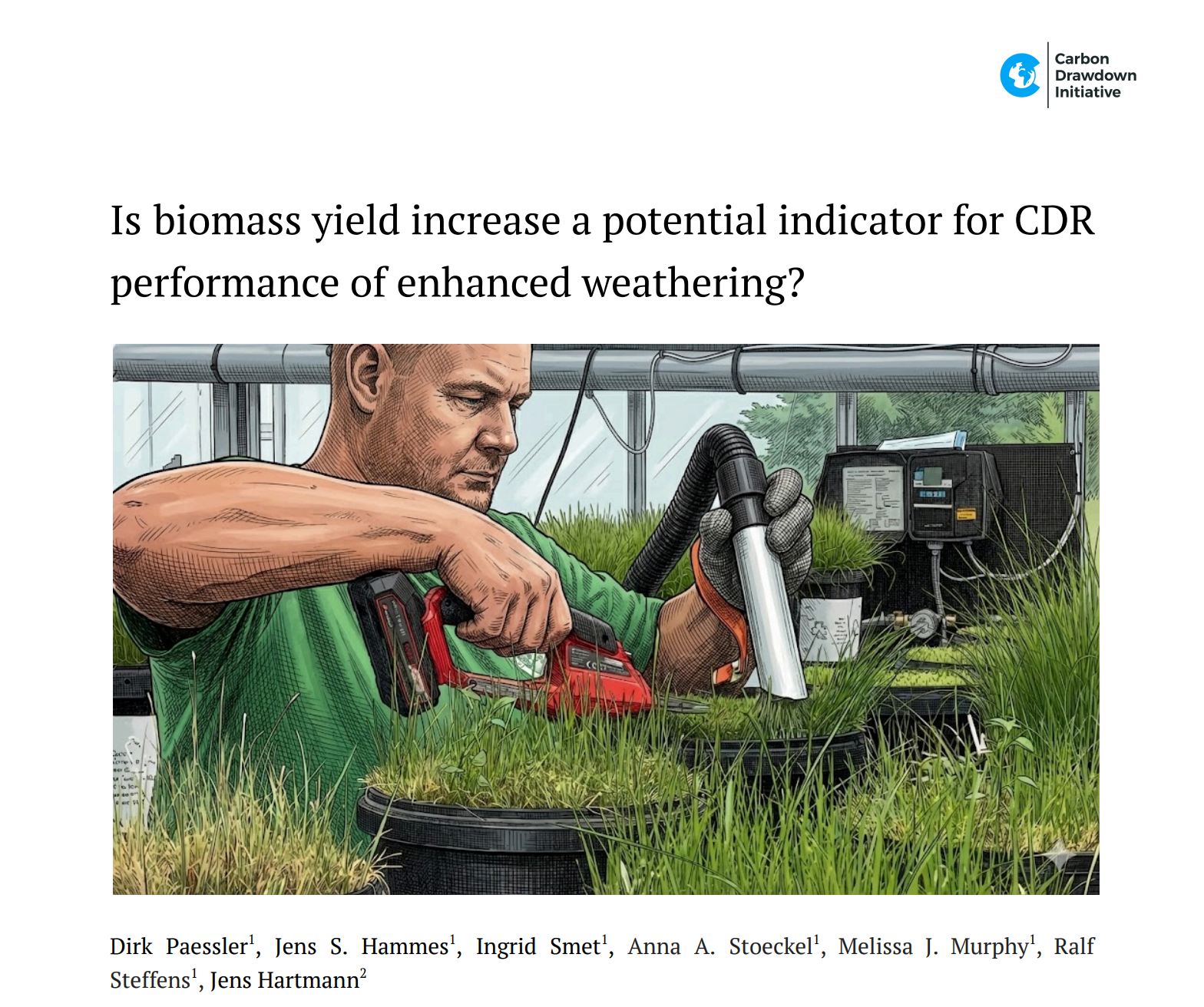
We’ve just published a new preprint that asks a very practical question for enhanced weathering (EW): if plants grow more after rock dust application, could that be an early indicator that carbon dioxide removal (CDR) is happening?
EW has a welcome “two-for-one” promise: as minerals dissolve, they can release nutrients and base cations (good for soils and plants) and at the same time increase the export of bicarbonate in leachate water—which we track as total alkalinity (TA), our key indicator that atmospheric CO₂ has been converted into the dissolved form, and is moving downward through the soil system. The challenge is that measuring TA reliably (and frequently enough) is still expensive and logistically hard—especially outside controlled setups.
So the question is: could crop yield/biomass be a useful, low-friction clue for identifying which rock-soil combinations are most likely to show a CDR signal?
What we did
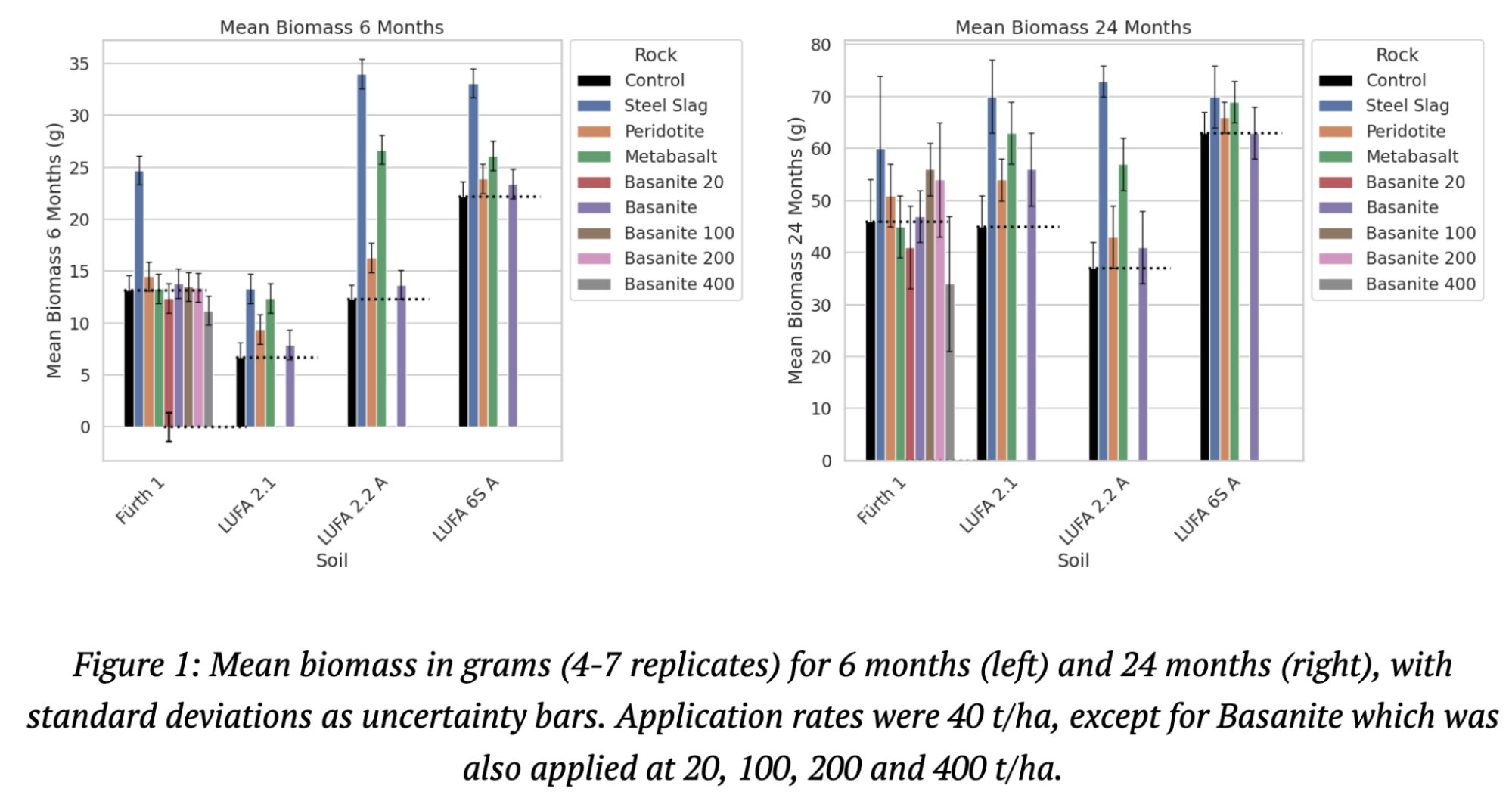
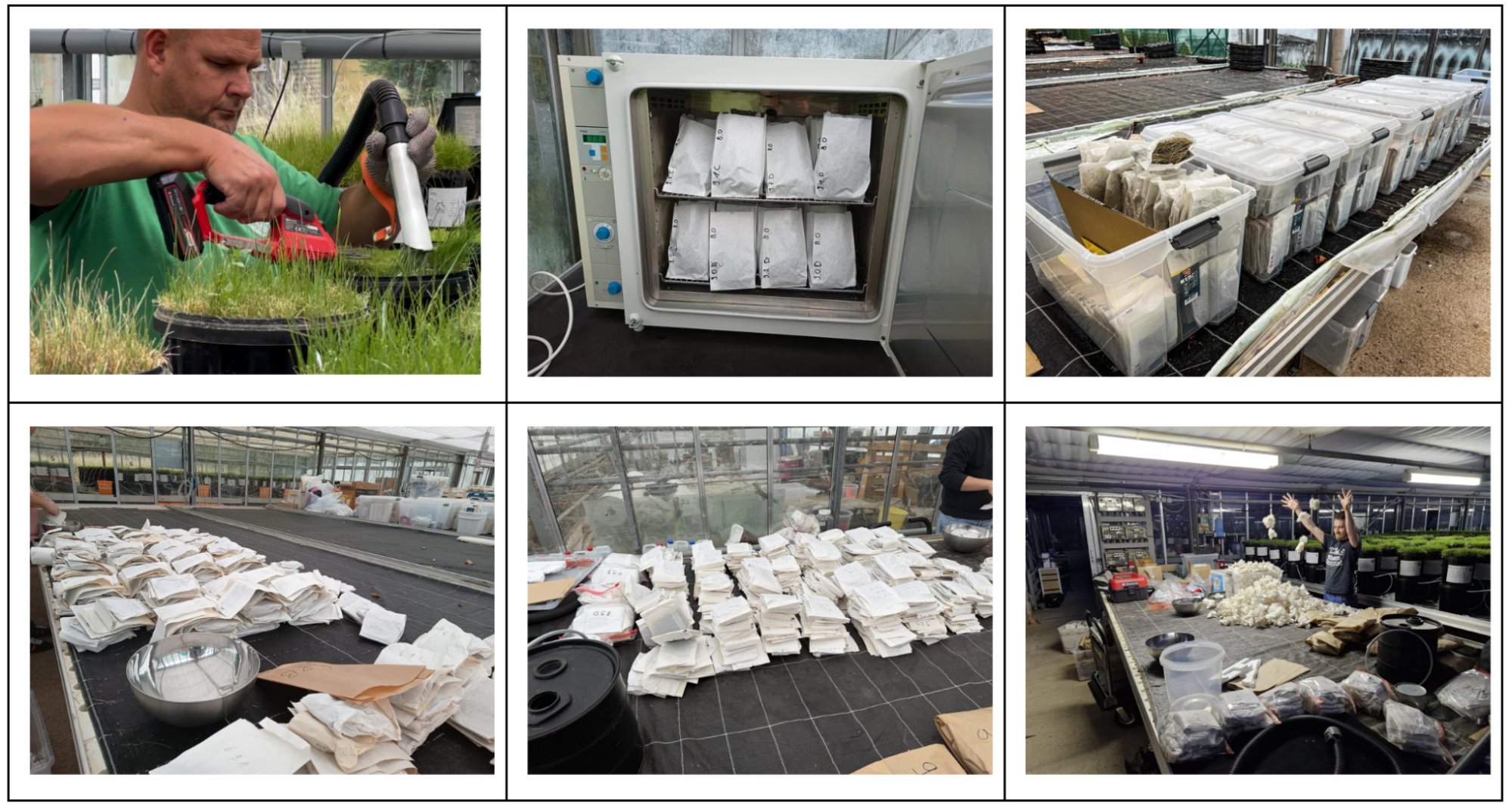
The dataset behind this preprint comes from our 2023/2024 greenhouse enhanced weathering experiment, where we grew Lolium perenne (ryegrass) on hundreds of lysimeters. Over the course of the experiment, we repeatedly harvested the grass (approximately 20 cutting events per pot), dried and stored the biomass, and compared total accumulated biomass after 6 months and after 24 months across 24 soil–feedstock variations (with 4–7 replicates per treatment). Biomass is reported as mean biomass yield (g), deltas are relative to their respective control. In parallel, we tracked EW-CDR performance using TA export in leachate water (expressed as the TA increase relative to controls).
What we found (and why we think it matters)
1) In many cases, TA increase and biomass increase showed up together
A simple summary of what jumped out from the data:
When TA export increased relative to the control, biomass often increased as well.
This pattern was not universal (more on that below), and the data does not yet tell us what is cause vs. effect—but the signal is strong enough that we think it deserves targeted follow-up.
2) The “relationship” looks soil-dependent
When we broke results down by soil type, the story got more nuanced:
For LUFA 2.2 A (a sandy loam, pH ~ 5.6, moderate CEC soil), we saw a strong, statistically supported linear relationship between biomass increase and alkalinity increase (r = 0.97, p = 0.006; R² ≈ 0.94).
For LUFA 2.1 (sand, low pH ~4.6, low CEC) and LUFA 6S A (sandy loam, high pH ~7.3, high CEC), correlations were also positive (r ≈ 0.86 and 0.76), but did not reach conventional significance—suggestive, not confirmed.
For Fürth soil (loamy sand, pH ~7.1, moderate CEC), there was no meaningful relationship (r ≈ -0.02), but on this soil the biomass increases were also minimal. Fürth soil remains our problem child…
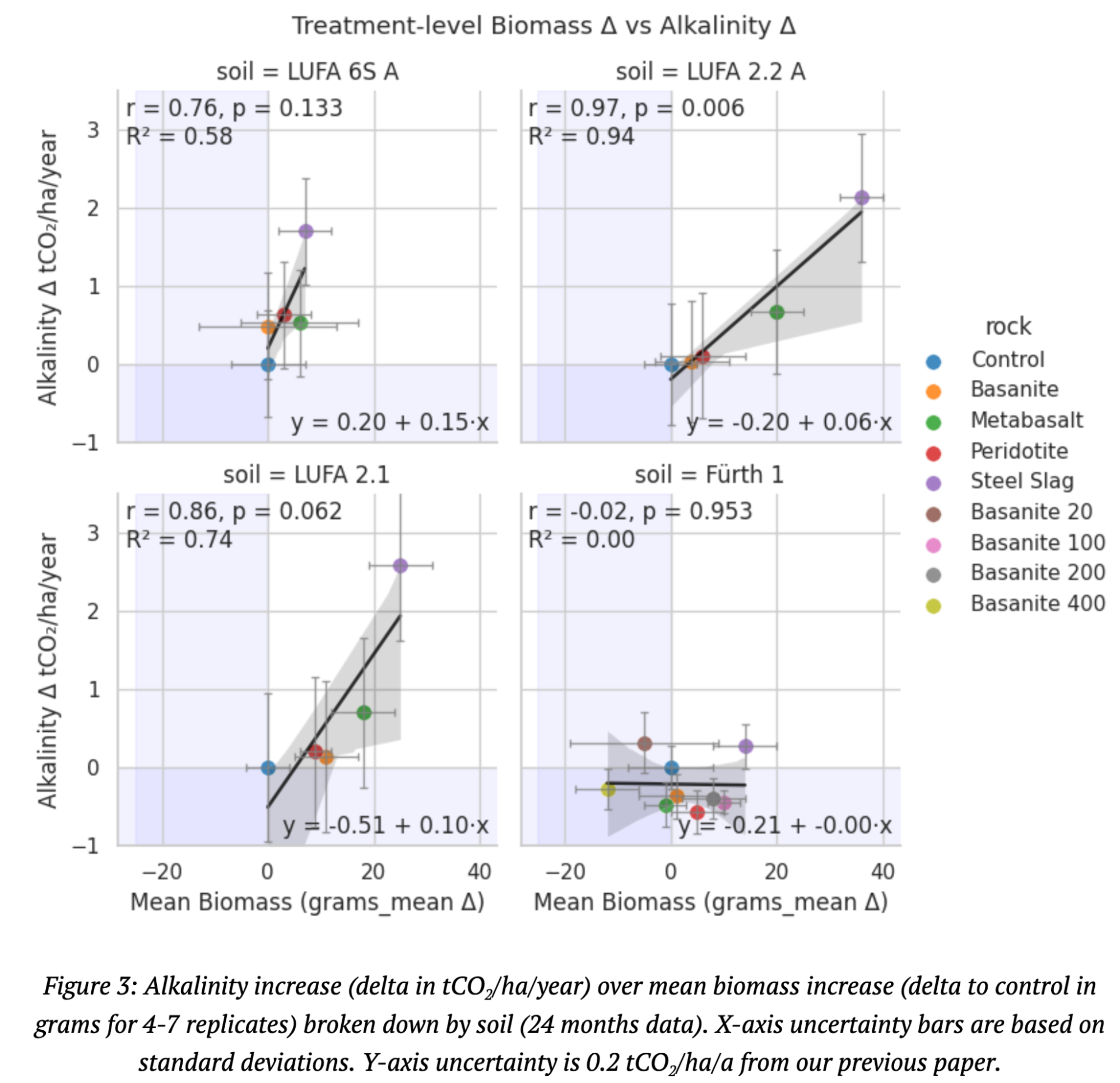
That last point is important: this is not a one-size-fits-all shortcut. If yield becomes a useful “early signal” at all, it will likely be conditional on a range of factors (including soil properties, feedstock choice, application rate, crop type, water regime etc.).
3) Across all soils, the association is positive (but not perfect)
Looking at all treatments together, we observed a positive association between biomass increase and TA increase:
Pearson correlation was r = 0.705 when using the 6‑month biomass data and r = 0.684 when using the 24‑month biomass data.
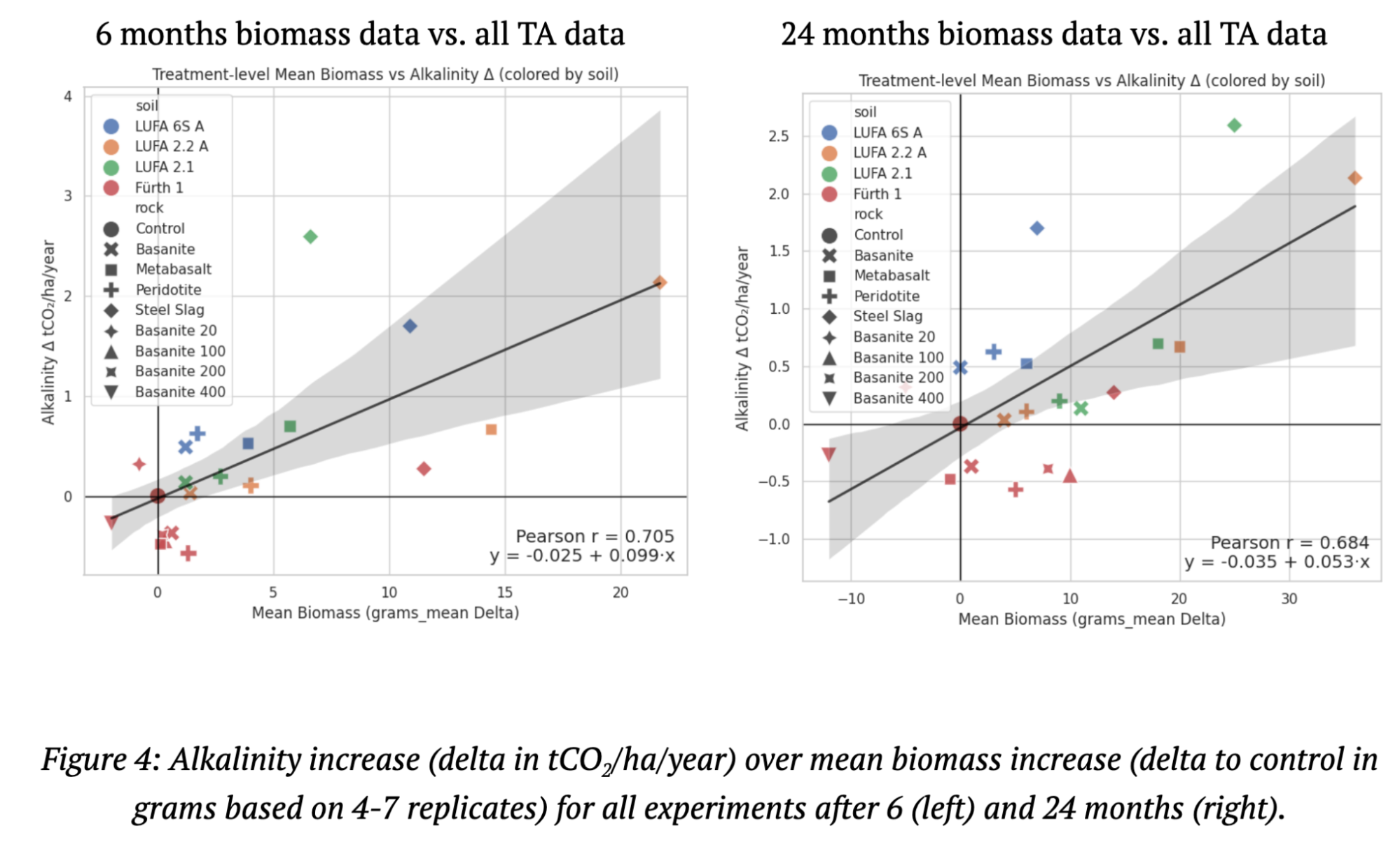
Interestingly, the longer-term correlation was slightly weaker than the shorter-term one—hinting that the strongest coupled effects might happen early, and then fade or get masked by other processes over time (e.g., rapid weathering of small and highly reactive mineral fractions, changing nutrient availability, or greenhouse-specific hydrology).
4) Feedstock choice (and dose) clearly matters for biomass response
Even without interpreting the mechanisms controlling these trends, the biomass data show consistent “who does what” patterns in our setup:
Steel slag was the most reliable driver of biomass increase across soils.
Metabasalt and peridotite also often increased biomass (depending on soil), while basanite showed the smallest effects in our dataset.
More is not always better: very high application rates can become detrimental. In the basanite dose series, biomass yield improved up to moderate doses of approximately 100-200 t/ha, but then dropped at the highest application rate (400 t/ha).
5) The yield effect often appears fast—and that’s the key “CDR operations” angle
In several treatments, we saw clear biomass differences only 6 months after feedstock application, and the relative increases in the first half-year were often larger than the relative increases observed after two years. If that early plant response turns out to be robust in field settings (and for at least some crop/soil/feedstock combinations), it could become operationally useful:
Early triage (deployment site assessment): rapidly identify promising EW site/treatment combinations, before investing heavily in expensive sampling campaigns or large scale spreading.
Field heterogeneity mapping: use aerial/remote sensing plant growth analysis to identify “clusters” of similar response and guide sampling locations (and extrapolations) more intelligently.
To be clear: biomass yield won’t replace MRV. But it might help decide where investment in MRV efforts (and maybe even large scale rock dust application itself) are most likely to pay off.
A note of caution (because this needs to be said up front)
This preprint is a “signal paper,” not a final answer, so caution is advised to avoid over interpreting soil-specific trends
Our observations come from a controlled greenhouse environment with constant irrigation and a single plant species.
The soils and feedstocks are specific, targeted selections (primarily soils from Germany), and even in our large experiment the number of measurements per variation remains limited.
Most importantly: We can't yet tell what is driving/causing what. Does faster weathering and higher alkalinity export improve plant growth? Or does stronger plant growth (and root CO₂ dynamics) accelerate weathering? Or do both respond to a third factor (like nutrient release, pH shifts, or soil physical changes)?
So the conclusion is not “yield proves CDR.”
The conclusion is: yield might be an early, cheap clue worth testing—carefully.
What’s next: work on understanding the mechanism is already underway
One of the most exciting parts of this story is that we’re not stopping at correlations.
We already have a large library of soil and biomass samples from the experiment, and additional measurements undertaken to investigate nutrient uptake, cation dynamics, and other mechanisms that could explain what we’re seeing. These results will be shared at our Carbon Drawdown Initiative symposium in June 2026.
Read the preprint
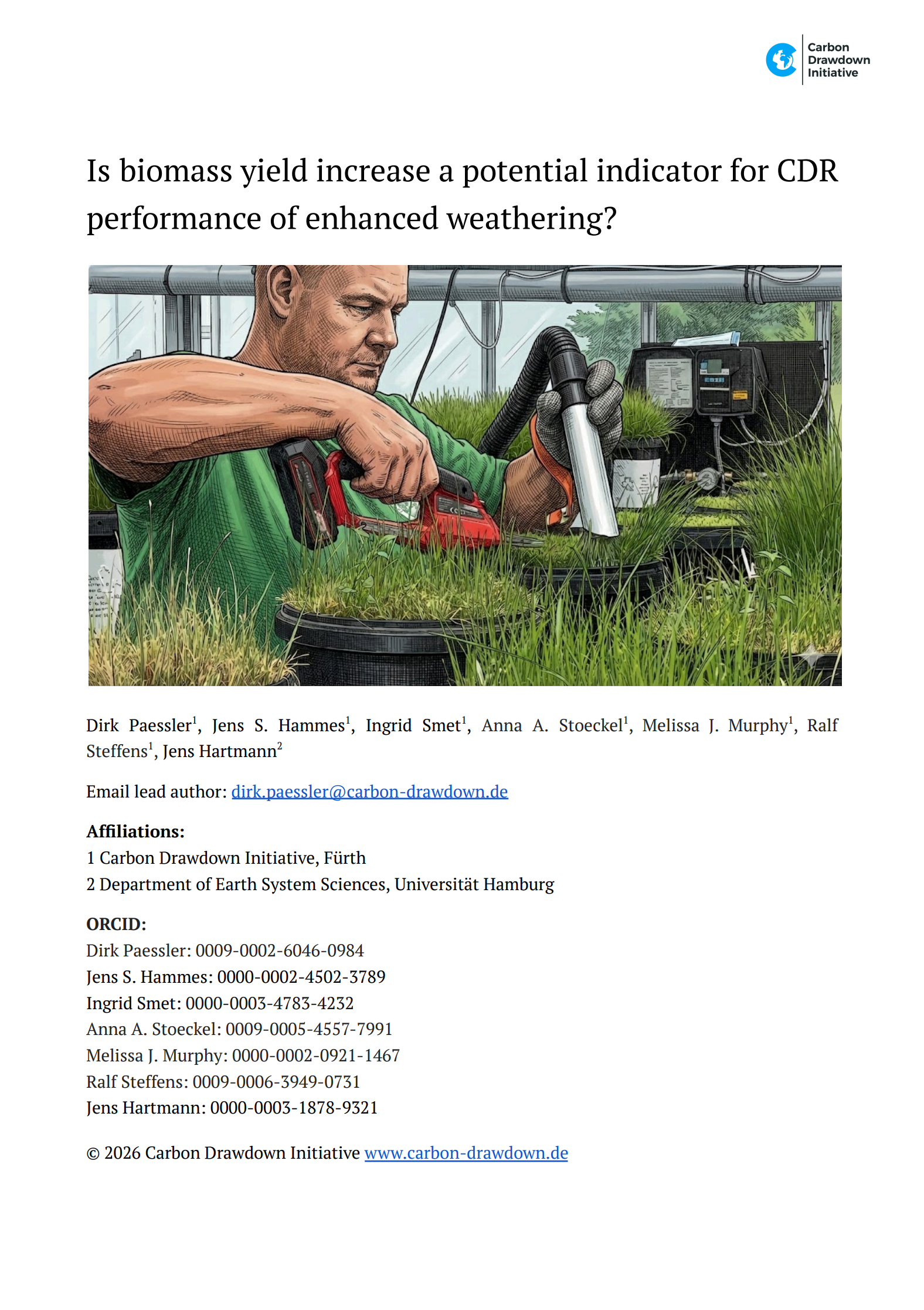
If you want the full details, figures, and statistics, you can read the full preprint here: Yield increase as early predictor of CDR performance of enhanced weathering (PDF, 2 MB)