Lifetime Carbon Balance of Enhanced Rock Weathering Explained, Part 2
What the Life-Cycle Assessment (LCA) actually measures and why that matters
If you read Part 1, you already know that every enhanced rock weathering (ERW) project must complete a full life-cycle assessment, or LCA, before a single carbon credit is issued.
But what does that really mean? And why does it matter so much?
Let’s unpack how an LCA keeps the science and the climate math honest.
The LCA lens
Think of an LCA as the balance sheet of a carbon removal project. Instead of tracking cash flow, it tracks CO₂-equivalent emissions from start to finish.
It tallies three main categories:
Scope 1: Direct emissions on-site, like diesel burned by excavators or tractors.
Scope 2: Indirect emissions from purchased electricity, for example the power used to run rock crushers.
Scope 3: Upstream and downstream emissions such as fuel production, transport distances, equipment manufacturing, and even disposal.
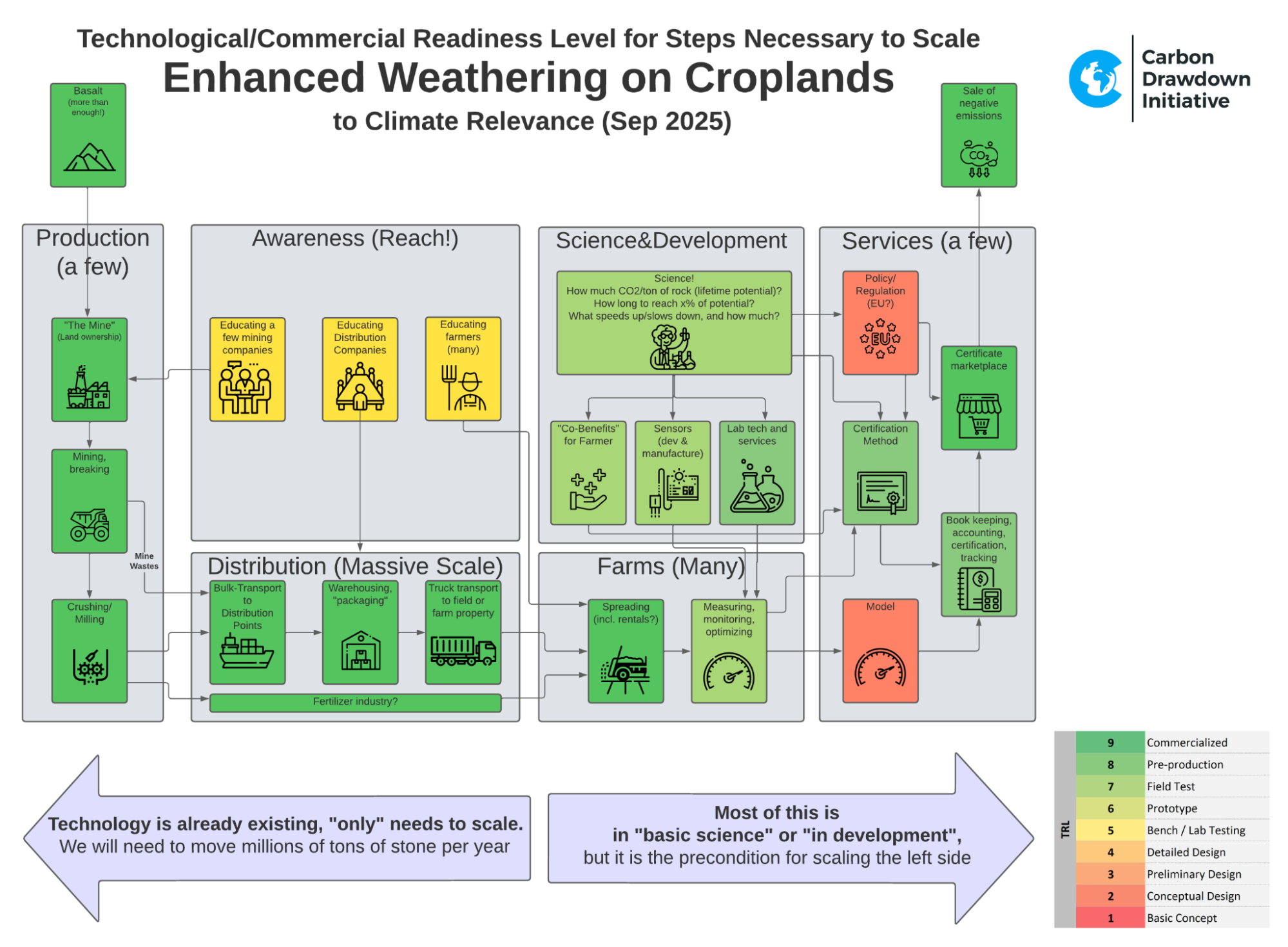
Everything that releases greenhouse gases within the project boundary must be included. Of course it matters where you draw these boundaries, as the complete chain of steps for an EW project is actually quite diversified, as the graph below shows. When setting the boundaries one also needs to take into account if some of the steps have already made efforts to net-zero their processes. We shouldn’t double account negative emissions as well as the actual emissions. You get the story: It actually turns into a complex matter quickly when you dig into this.
From assumptions to data
Puro.Earth and Isometric both require LCAs to use standardized emission factors from recognized databases such as ecoinvent or ISO 14040/44 guidelines.
That means:
No guessing
No assuming renewable equals zero
Every data point must have a traceable source and uncertainty range
If the electricity comes from solar, for instance, the LCA still counts the emissions from building and maintaining the panels.
When uncertainty exists, the rule is simple: err on the side of higher emissions.
Why it builds trust
This rigor matters because carbon credits only work if buyers and the atmosphere can trust them. By forcing projects to disclose the full picture, LCAs prevent double counting and greenwashing.
They ensure every tonne of CO₂ sold truly represents a net tonne removed from the air. That’s why the best ERW credits today come from methodologies that demand this level of transparency.
They may look slower or more expensive, but they are real.
The bottom line
A credible LCA does more than prove that enhanced rock weathering removes more CO₂ than it emits. It shows exactly how much more and documents the evidence for anyone to verify.
What’s next in the series
Part 3: Why waste rock flips the math — how using industrial by-products and mine tailings can make enhanced weathering even more carbon-efficient.
Sources
CDI EW value-chain graphic: https://www.carbon-drawdown.de/blog/2025-9-30-the-progress-of-enhanced-weathering-as-a-solution-for-the-climate-crisis-in-a-trl-chart-updated
Puro.Earth ERW methodology and LCA requirements: https://puro.earth
Isometric Standard for ERW and LCA guidance: https://www.isometric.com
Ecoinvent lifecycle emission database: https://www.ecoinvent.org
ISO 14040/44 LCA standards overview: https://www.iso.org/standard/76126.html