Lifetime Carbon Balance of Enhanced Rock Weathering Explained, Part 1
Doesn’t mining and grinding the rock emit more CO₂ than it captures?
This is the most common question I get when I explain enhanced rock weathering (ERW) as a climate solution. It sounds logical: if we have to mine, crush, and transport millions of tons of rock dust, how could that possibly be carbon-negative?
Here’s the answer, backed by data, not optimism.
Every Step Is Counted
The people working on enhanced weathering science and projects are of course kept up at night by the same concerns: Are we making sure that we actually make things BETTER, not worse? Nobody in the world is making huge profits (if any at all) from weathering projects currently, so when we spend all this money, how can we make sure that we are actually helping the climate with these efforts?
Before a single carbon credit is issued, every carbon removal project must pass a cradle-to-grave Life-Cycle Assessment (LCA), otherwise independent third-party auditors like Isometric and Puro.Earth will not certify the project.
That means every source of CO₂, no matter how small, is taken into account and subtracted from the final balance.
Here’s what’s included:
Mining and Extraction -– (fossil?) fuel used for excavation, drilling, or blasting.
Grinding and Processing -– the electricity or fuel powering crushers and mills.
Transport -– emissions from moving the rock dust to farms or fields.
Field Application -– diesel from tractors and spreaders used to apply it.
Nothing is left out or “assumed clean.” Even the electricity for grinding — , whether grid-based, solar, or otherwise —, carries its own documented emission factor. Oh, any by the way: The “greener” the grids become and the more electric machinery is involved in these processes, the lower the emissions will be.
The result: a complete, transparent carbon ledger from mine to field.
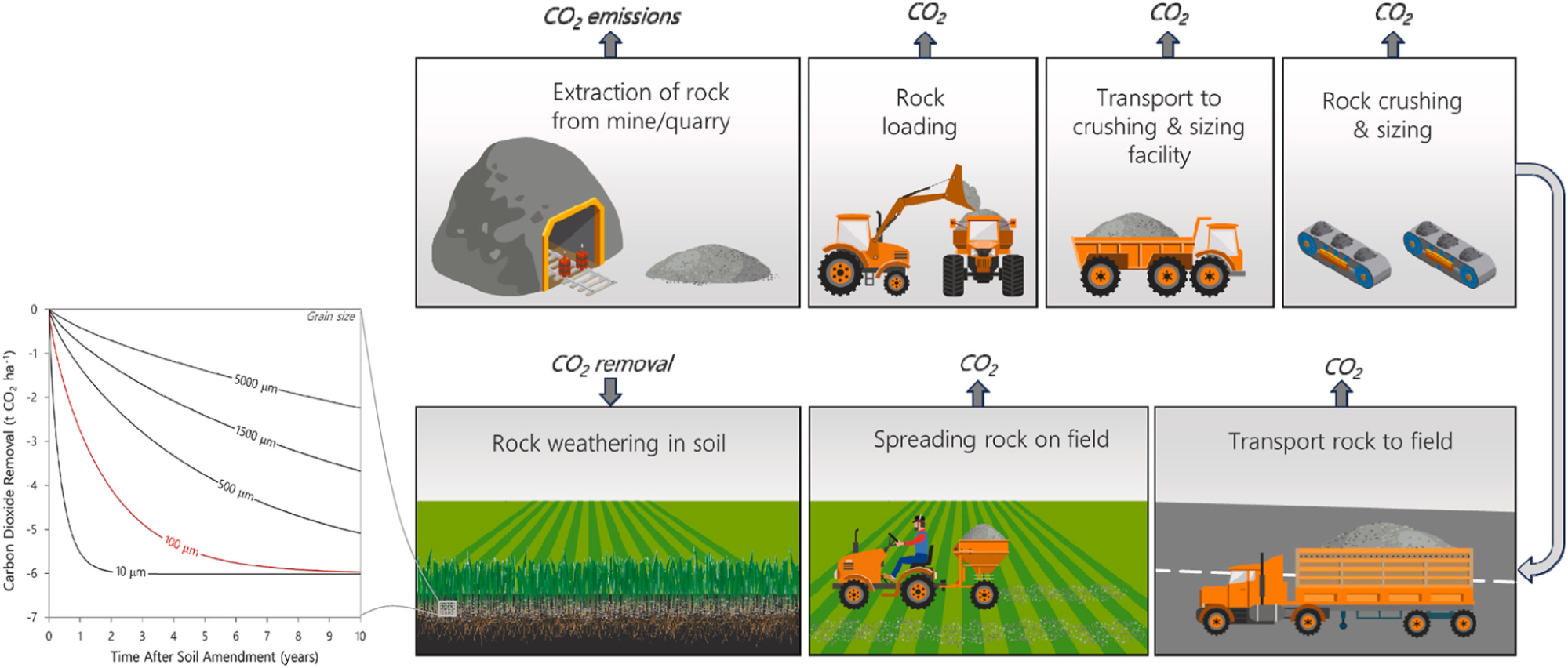
A visualization from study “The impact of geochemical and life-cycle variables on carbon dioxide removal by enhanced rock weathering: Development and application of the Stella ERW model” (Jerden, et al., 2024) https://www.sciencedirect.com/science/article/abs/pii/S0883292724001070
The Real-World Math
In InPlanet’s 2024 field trials in Brazil, the complete process emitted about 18 kg CO₂ per tonne of basalt applied. That same tonne of rock theoretically removes 250-–300 kg of CO₂ through weathering reactions over time. This value is based on stoichiometric calculations which take the chemical composition of the material into account. Which means that even after subtracting the process emissions, that’s roughly 230-–280 kg of net CO₂ removed per tonne.
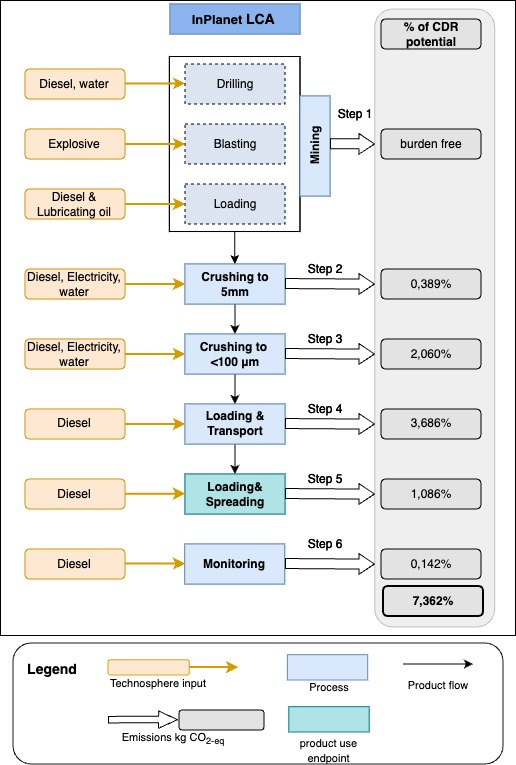
From Inplanet: Life Cycle Assessment (LCA) case study for São Paulo
Look at this graph from the InPlanet website on the right, it shows the various CO₂ sources of the whole process in % of the potential CDR effect that the rock has (based on chemical composition, per ton of rock). In the end only 7,4 % of the CDR effect is counter balanced by the necessary emissions.
When we did a 1217 ton basalt EW project in 2021 we also did a LCA calculation. We found the actual emissions of our project to be 44,6 tons CO₂. Similar to the InPlanet data the emissions were also less than 10% of 1217 t basalt’s CDR potential of 509 t CO₂. Even though we drove the truck for 250 km.
Other studies (Beerling et al., 2018; Nature Communications Earth & Environment, 2022) show similar ranges. The most energy-intensive step— (grinding) —is measurable and, crucially, dwarfed by the CO₂ captured when the rock dissolves.
Admittedly, it will take years to decades to reach the full potential of the rock, and there are also some processes in the soil that take away a part of the potential. The exact numbers are a matter of ongoing scientific work.
That is why ultimately EW credits are usually based on actual measurements that can proof the rock dissolution and/or the successful carbon transport (e.g. by measuring leachate total alkalinity which indicates how much carbon has been captured in the form of bicarbonate in the leachate).
Built-In Conservatism
Both Puro.Earth and Isometric intentionally overestimate emissions and under-credit removals. They require ISO-compliant LCA methods, 100-year global warming potential factors, and transparent documentation of uncertainty. If a project can’t prove a net-negative result, it doesn’t qualify.
That’s why ERW credits under these standards are among the most conservative and credible forms of carbon removal available today.
Why This Matters
Enhanced rock weathering uses Earth’s natural chemistry to lock up carbon safely and permanently. When done with full LCA transparency, it’s one of the few scalable solutions that truly removes more CO₂ than it emits.
So yes, grinding the rock costs carbon but the planet still wins by an order of magnitude.
Next in the Series
Part 2: What the LCA actually measures and why that full accounting is the foundation of trust in ERW.
Sources:
Jerden et al., 2024 — Stella ERW model: https://www.sciencedirect.com/science/article/abs/pii/S0883292724001070
Beerling et al., Farming with Crops and Rocks (2018): https://www.nature.com/articles/s41561-017-0052-5
Nature Comm. Earth & Environment (2022): https://www.nature.com/articles/s43247-021-00305-4
InPlanet LCA process emissions: https://www.inplanet.earth
Carbon Drawdown Initiative 2021 project: https://www.carbon-drawdown.de/blog/2022-12-14-how-cdr-with-rock-weathering-can-be-done-practically-and-profitably-part-1
Stoichiometric CDR potential references: https://www.nature.com/articles/nclimate1384
Isometric Standard (MRV + LCA): https://www.isometric.com/standard
Puro Standard (methods library): https://puro.earth/document-library