A Map of Hope: 700+ Carbon Removal Companies Around the World
The other day I came across a list of more than 700 carbon dioxide removal (CDR) companies that Grant Faber has compiled on Carbon Based Commentary. It is the most complete public list I have seen of who is actually building the tools that could one day pull billions of tons of CO₂ from the atmosphere.
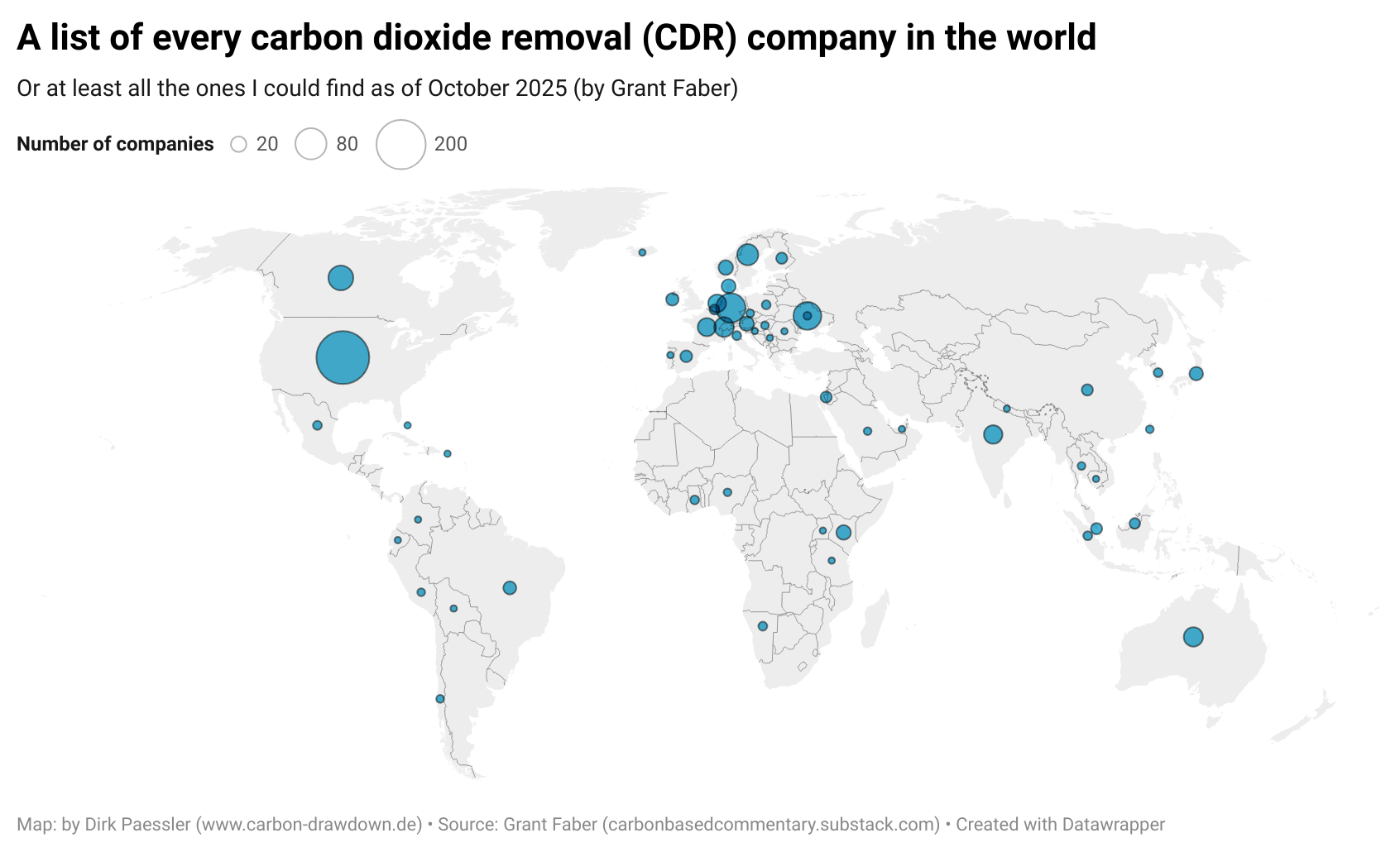
Interactive map: View here
I was curious to see what that looks like globally, so I made a world map showing the number of companies in each country.
What emerges is both fascinating and encouraging.
Roughly one third of all CDR companies are based in the United States. That is a big concentration, but it also means that two thirds of the effort happens elsewhere. Europe shows a dense cluster of activity, with the United Kingdom, the Netherlands, Switzerland, and the Nordic countries all punching above their weight.
My home country, Germany, comes in second place worldwide with around 9.1 percent of all listed companies. That number surprised me in the best possible way. When you look at the map, you realize that CDR is no longer a niche or regional experiment. It is a truly global industry in the making. From the Andes to Australia, from Kenya to Korea, people are running field trials, building new machines, and developing measurement tools to make carbon removal measurable, verifiable, and scalable.
This kind of distribution gives me hope.
It shows that the idea of removing CO₂ from the atmosphere has reached the stage where it no longer depends on a single government, economy, or investor ecosystem. The tools, talent, and ambition are spreading everywhere.
That matters right now because the United States administration has recently chosen to slow down, if not completely withdraw, from major climate commitments. That decision will almost certainly hurt some of the very innovators who have been building the country’s strong position in CDR.
The bigger picture is more encouraging. The rest of the world is still moving forward. Many of these young companies outside the U.S. are more determined than ever to prove that the work can continue, with or without American leadership.
In a way, this global spread is what makes the climate movement more resilient. If one region hesitates, another accelerates. If one country cuts budgets, another finds new investors or regional funding.
The work continues.
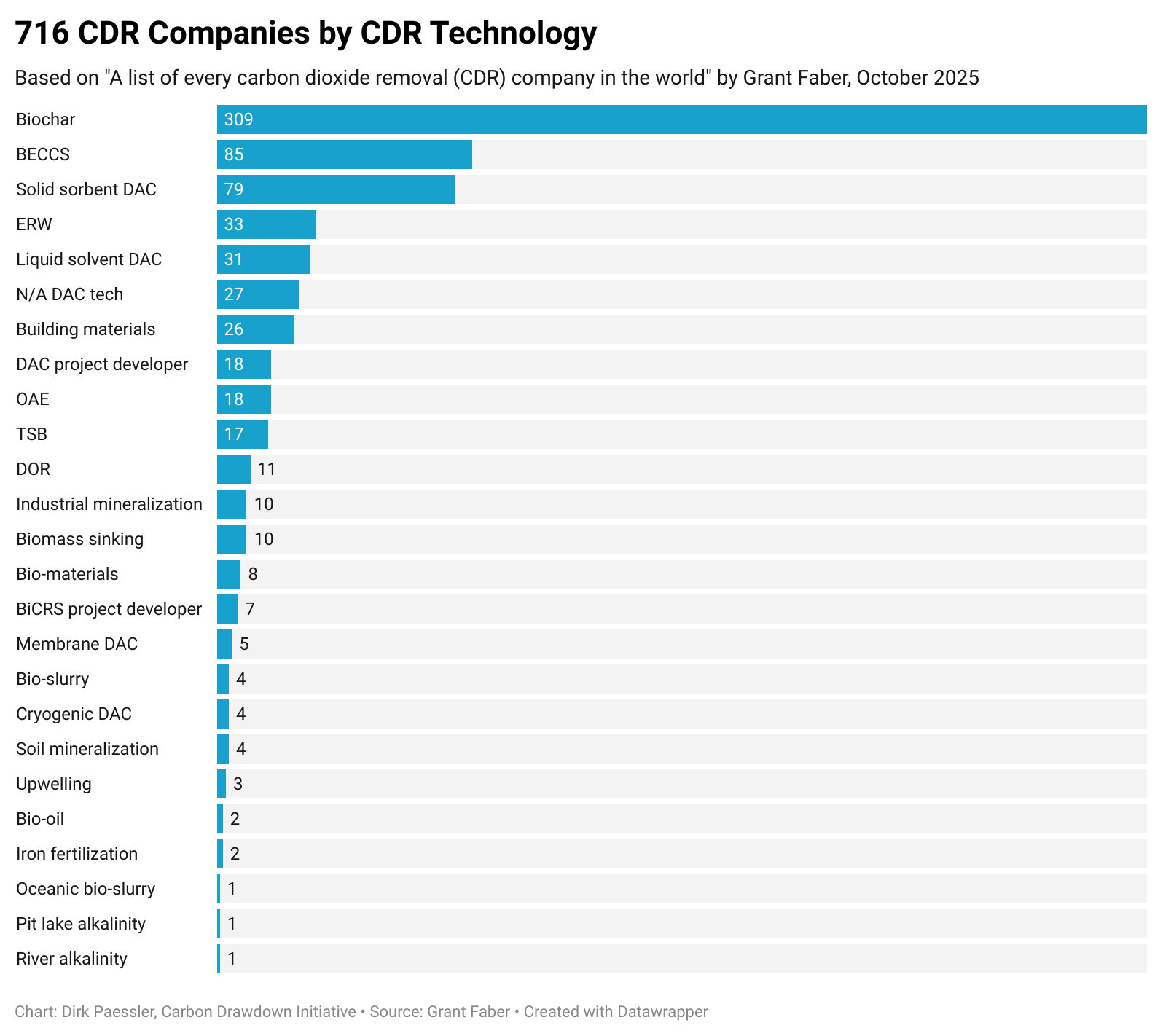
Interactive chart: https://www.datawrapper.de/_/jhgxn/
I also find it interesting how diverse the field has become. A few years ago, most people would have thought of carbon removal as either direct air capture or tree planting. Now, the list includes enhanced weathering projects, biochar producers, ocean alkalinity experiments, mineralization pilots, biomass utilization startups, and hybrid approaches that combine biology, chemistry, and data science.
That variety is a good sign. It means we are collectively exploring multiple pathways instead of betting everything on one silver bullet. We are in the phase of global experimentation, and every failed or successful project moves the science forward.
Creating this map reminded me of something I learned long ago in business: the more distributed an effort becomes, the harder it is to stop. That is exactly what we need in carbon removal, the challenge is far too big for one continent, one technology or one company to handle.
We will need the best ideas from everywhere, and the kind of practical optimism that drives scientists and founders to build rather than debate.
If you work in CDR, take a look at the data and check whether your company is listed. Grant himself notes that “with 708 companies, an English-language bias, and a fast-moving landscape, I’m 100% confident the list is not 100% correct, but 90% confident it’s 90% correct.” You can help improve that confidence by submitting new or updated entries.
Every point on this map represents people who decided to act. Together, they form a network that is slowly, methodically, and optimistically reshaping our relationship with the atmosphere.
The rest of the world is stepping up. Let’s keep it that way.
Interactive map: View here
Source: Grant Faber, Carbon Based Commentary