Lifetime Carbon Balance of Enhanced Rock Weathering Explained, Part 3
Why Waste Rock Flips the Math and Supercharges ERW’s Net Carbon Balance
If Part 1 and Part 2 laid out how enhanced rock weathering (ERW) accounts for every gram of CO₂ emitted, Part 3 is about something even more interesting: how using already-mined material turns the carbon math from “good” to “dramatically better.”
This is where industrial by-products and mine tailings change the game.
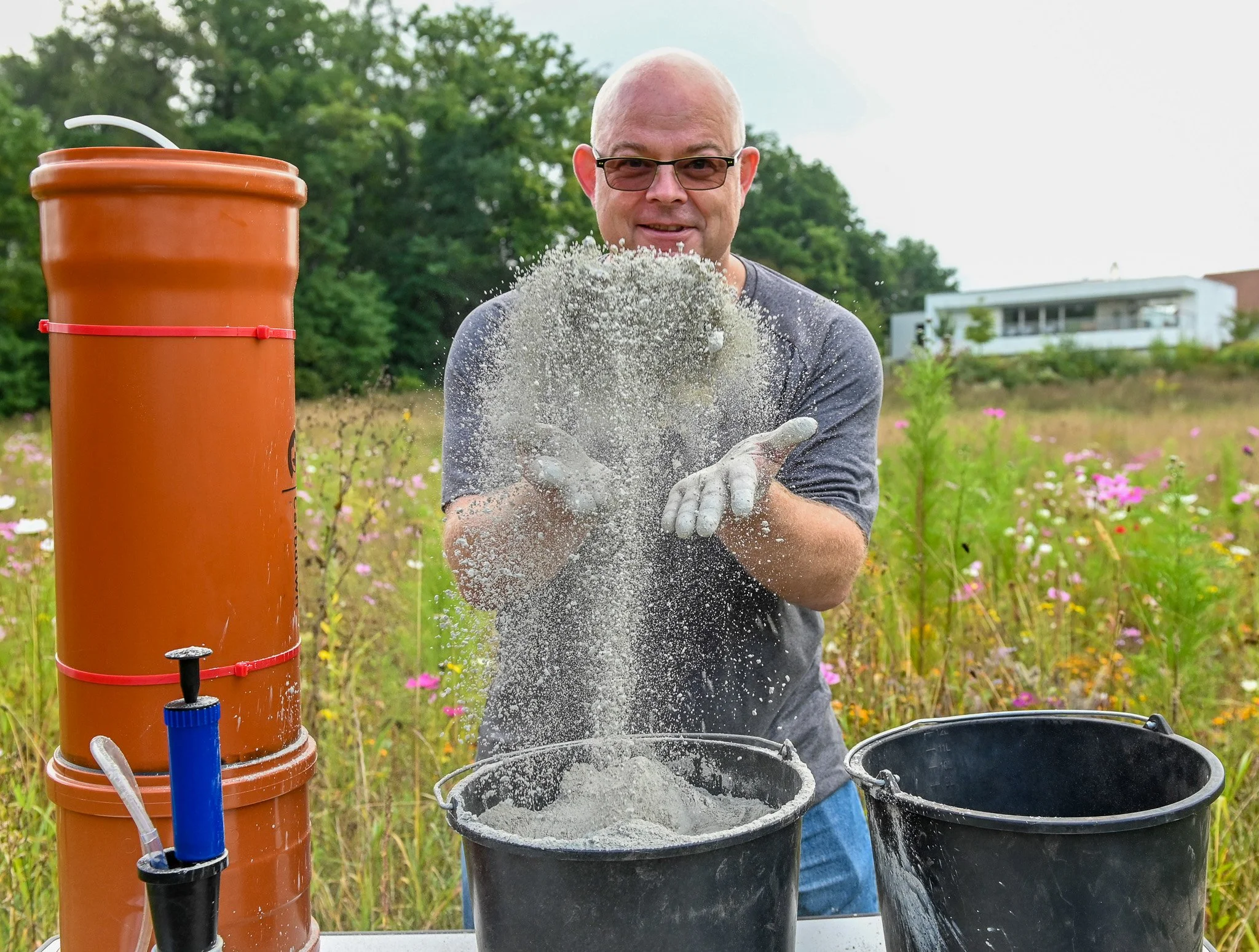
This are basalt fines, leftovers from basalt gravel production.
The Hidden Advantage of “Waste” Rock
If you don’t have to mine the rock, two major LCA categories shrink immediately:
Extraction emissions – nearly zero
Tailings, by-products, and fines have already incurred their environmental cost. The diesel burned and explosives used? Already accounted for in the primary product’s LCA.Grinding emissions – often dramatically lower
Much of this material is already fine-grained. Waste fines from quarries or crushing plants often require little to no additional milling to reach ERW-ready particle sizes. And if some regrinding is needed, it starts from a partially processed state, not a fresh boulder.
For many rock types, grinding is the single largest contributor to ERW’s embodied emissions. So skipping most of it matters.
A closely related category deserves special mention: glacial rock flour. In practice, glacial dust behaves like a naturally generated mine tailing – produced not by machinery, but by ice. Glaciers grind bedrock into extremely fine material over thousands of years, creating rock flour which has the smallest grain-size distribution available for ERW feedstocks.
Where These Materials Come From
Across industries, enormous amounts of suitable material are piling up unused:
Basalt quarry fines – a perfect ERW candidate and often already at <2 mm.
Cement and aggregate dusts – silicate-rich by-products already in powder form.
Mining tailings – ultrafine residues stored in ponds and piles, often at exactly the reactive size distribution required for rapid weathering.
Industrial slags (depending on composition) – in some cases reactive alkaline materials with large carbonate potential.
Glacial rock flour – naturally milled material produced by glacial erosion, available at a very large scale in regions like Greenland. Functionally, it behaves like naturally generated mine tailing: already extracted, already pulverized, and already at an exceptionally fine grain size.
These piles are liabilities for industry but assets for ERW. When diverted into weathering projects, they unlock carbon removal with minimal new emissions.
The Carbon Effect: Multiplying the Net-Negative Outcome
Let’s revisit the simplified math from Part 1.
A tonne of fresh basalt:
~18 kg CO₂ emitted (Brazil example)
250–300 kg CO₂ removed over time
Now compare that with quarry fines or tailings:
Mining emissions: 0 (allocated elsewhere)
Grinding emissions: near 0
Transport + field application: often the only significant contributors
In some LCAs (including our own exploratory analyses at CDI), waste-rock-based ERW can reduce total process emissions by 60–90%.
That means the net removal per tonne of material doesn’t just stay strong, it becomes even more carbon-efficient. Feedstocks that are already ultra-fine push this efficiency further. When little to no additional grinding is required, one of ERW’s largest embodied-emission sources nearly disappears.
If these materials can be moved primarily by ship – rather than long road-haul logistics – the remaining footprint shrinks again. Bulk maritime transport, especially from regions like Greenland, has one of the lowest CO₂ intensities per tonne-kilometer available today.
In extreme cases, the process emissions drop to single-digit kilograms per tonne applied, while the weathering potential stays the same. The signal-to-noise ratio improves dramatically.
A Bonus Benefit: Faster Deployment
Using waste rock also:
Removes permitting barriers (no new mines)
Reduces cost (material is often free)
Speeds up scaling (stockpiles already exist at gigaton scale globally)
Materials that are already loose, fine-grained, and stockpiled shorten deployment timelines even further – often eliminating entire project phases before field application even begins.
Why This Matters
If ERW is going to reach meaningful scale – hundreds of millions of tonnes annually – reducing the “energy overhead” is essential. Waste rock doesn’t just make ERW more carbon-efficient. It makes it cheaper, faster, and more deployable.
It flips the LCA from “very good” to “exceptional.”
Next in the Series
Part 4: Why MRV (Measurement, Reporting, Verification) is the spine of trustworthy ERW and how modern geochemistry proves carbon is truly removed.
Sources — Newsletter Part 3 (Waste Rock & ERW Carbon Balance)
Jerden et al., 2024 — The impact of geochemical and life-cycle variables on carbon dioxide removal by enhanced rock weathering
https://www.sciencedirect.com/science/article/abs/pii/S0883292724001070Beerling et al., 2018 — Farming with Crops and Rocks
https://www.nature.com/articles/s41561-017-0052-5Nature Communications Earth & Environment, 2022 — ERW dissolution dynamics
https://www.nature.com/articles/s43247-021-00305-4InPlanet — LCA process emissions & field trial data
https://www.inplanet.earthCarbon Drawdown Initiative — 2021 basalt EW project LCA
https://www.carbon-drawdown.de/blog/2022-12-14-how-cdr-with-rock-weathering-can-be-done-practically-and-profitably-part-1Stoichiometric CDR potential (materials & dissolution chemistry)
https://www.nature.com/articles/nclimate1384Puro.Earth — ERW methodology & LCA requirements
https://puro.earth/document-libraryIsometric Standard — MRV & LCA guidance
https://www.isometric.com/standard