Lifetime Carbon Balance of Enhanced Rock Weathering Explained, Part 4
Why MRV Is the Backbone of Trust and How We Actually Prove the Carbon Is Gone
Parts 1–3 explained the inputs: emissions, boundaries, and smarter material choices. Catch up with these links: Part 1, Part 2, and Part 3.
Now we arrive at the part that matters most to the atmosphere – proof.
Enhanced rock weathering only works as a climate solution if we can measure the carbon removed, not just model it. That’s where MRV comes in.
What MRV Really Does
MRV (Measurement, Reporting, Verification) provides the evidence that carbon has actually left the atmosphere and been safely stored as bicarbonate in groundwater or oceans.
A robust MRV framework answers three questions:
How much rock dissolved?
How much CO₂ did that dissolution consume?
Where is the carbon now, and is it stable?
This isn’t theoretical. It’s quantifiable geochemistry.
How We Measure Removal in ERW
There are several evidence pathways, all involve some or even many measurements over time:
1. Geochemical tracers and isotope ratios: Weathering leaves a chemical fingerprint. Changes in the ratios between elements like magnesium, calcium, titanium, or even some isotopes reveal how much of the applied rock has already been dissolved, because some elements tend to stay where they dissolved, while others are washed out more quickly after dissolution. By monitoring the ratios in soil samples we can estimate the weathering rate over time.
2. Total alkalinity in leachate or groundwater (or even on catchment scale): As the rock or feedstock dissolves the cations balance bicarbonate ions in the leachate water which travels through soil into ground water and eventually to streams and the ocean. There the carbon is effectively stored for very long time frames and it helps balance the acidification of the oceans. Measuring total alkalinity (TA) shows: how much bicarbonate is leaving the system in the leachate, which directly correlates to CO₂ removed. This is why so many field projects, including CDI’s greenhouse experiments, continuously monitor TA in leachate.
With the same concept it should be possible for very large projects to monitor for such changes in the chemistry of small creeks/rivers which feed from large feedstock-treated fields.
3. Proxies: The first 2 methods are proofing weathering rather directly by either looking at the “input” (remaining rock) or the output (“alkalinity increase”) of the system. Both tend to be more complex and expensive when done at large scale and/or very often. So scientists are looking at several, potentially cheaper proxy methods that could be used to estimate the other two. For example the weathering in most cases changes the pH or EC of the leachate water, both of these metrics are easy and quick to measure. The change in biomass (amount and quality) could also give some indication whether the rock has actually started to dissolve. This is an area of active research with the goal to lower MRV cost.
For most MRV projects two of the various measurement options are used, one to prove the other. One of the challenges is the heterogeneity of the field’s area and getting the balance right between cost and rigor: Too many measurements might make the whole project uneconomical, too few measurements might end up in too much uncertainty.
In the end we want indications of weathering with as little uncertainty as economically possible.
Why MRV Is Conservative by Design
Both Isometric and Puro.Earth require that MRV:
uses high-confidence measurement pathways
subtracts all uncertainties
discounts anything that cannot be directly demonstrated
excludes model-only removals unless backed by evidence
applies conservative stoichiometry, even when real conditions may outperform theory
If uncertainty exists, credits are reduced – sometimes significantly.
This is why early ERW credits appear “lower” than theoretical weathering potential. It’s not because ERW is weak; it’s because MRV frameworks intentionally undercount until data proves more.
Better to issue fewer credits that are real than many that are questionable.
The Future: Higher Confidence, Lower Uncertainty
As the science matures, MRV is rapidly improving:
Automated leachate and groundwater monitoring
High-resolution geochemical modelling
Tools to better understand in-field heterogeneity (e.g. based on drone or satellite data)
Better tracers to distinguish soil vs. applied rock contributions
Faster lab techniques for mineral dissolution analysis
Larger databases with actual measurements data from field trials (urgently needed)
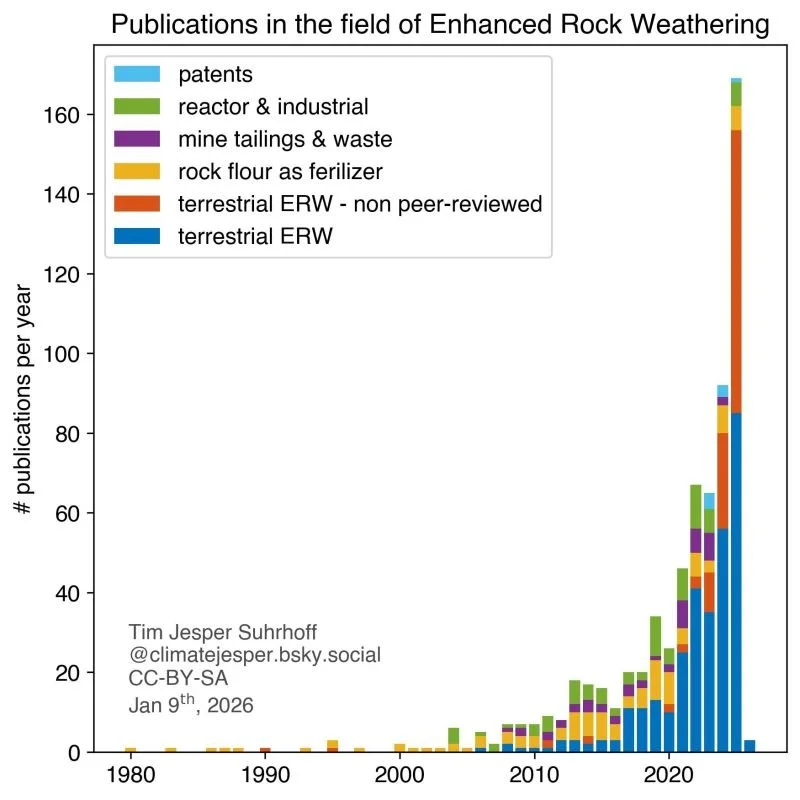
As a matter of fact, the number of new scientific publications on enhanced weathering each year is growing exponentially.
The trend is clear: uncertainty is shrinking. Verified tonnes will rise.
This is how ERW becomes a mainstream carbon removal method: by proving, not promising.
The Bottom Line
Enhanced rock weathering has one of the strongest “trust backbones” in carbon removal.
LCAs ensure we count every emission. Waste rock improves the efficiency of the whole system. And MRV provides the scientific evidence that carbon truly left the atmosphere.
When all three pieces are in place, we get one of the most scalable, scientifically grounded, and transparent carbon removal pathways available today.
Series Complete
Thank you for following along. If you want a bonus topic, I’m happy to add Part 5: The biggest bottlenecks to scaling ERW and how we solve them.
Just say the word.
Sources
CDI EW value-chain graphic (process steps + system boundaries)
https://www.carbon-drawdown.de/blog/2025-9-30-the-progress-of-enhanced-weathering-as-a-solution-for-the-climate-crisis-in-a-trl-chart-updatedIsometric Standard for ERW — MRV + evidence pathways
https://www.isometric.com/standardPuro.Earth — ERW MRV and conservative crediting requirements
https://puro.earthEcoinvent — lifecycle emission factors
https://www.ecoinvent.orgISO 14040/44 — LCA standards
https://www.iso.org/standard/76126.htmlBeerling et al., 2018 — ERW geochemical foundations
https://www.nature.com/articles/s41561-017-0052-5Kelland et al., 2020 — geochemical tracers & dissolution modelling
https://www.nature.com/articles/s41467-020-14855-0CDI greenhouse experiment documentation (alkalinity monitoring, dissolution evidence)
https://www.carbon-drawdown.de/blog