The soil breathes: how temperature and CO₂ drive the weathering signal
Our XXL Lysimeter Experiment, Article 3 of 6
In article 2 the leachate refused to separate the doses. Now we turn to the buried sensors, and the tone changes: they reveal a clean, repeatable engine that the monthly grab samples alone would never show. The soil breathes with the seasons, and that breathing drives the whole weathering signal.
The chain we can see in the data runs: warmer soil → more respiration → more soil CO₂ → more carbonic acid → lower leachate pH → more alkalinity. Every link is visible in the sensors, and it holds across every dose.
Link by link
Each instrumented pot logs soil temperature, and every pot logs soil CO₂ at ~20 cm, every day — twenty sensors, four per dose. Pairing the daily sensor record with each dose’s monthly leachate sample and pooling across all doses gives the chain directly:
Temperature → soil CO₂: r = +0.58. Warm soil respires; roots and microbes exhale CO₂.
Soil CO₂ → leachate pH: r = −0.74. More CO₂ makes more carbonic acid, and the drainage turns more acidic.
Soil CO₂ → leachate alkalinity (TA): r = +0.58. That acidity is what dissolves minerals and releases the bicarbonate we measure.
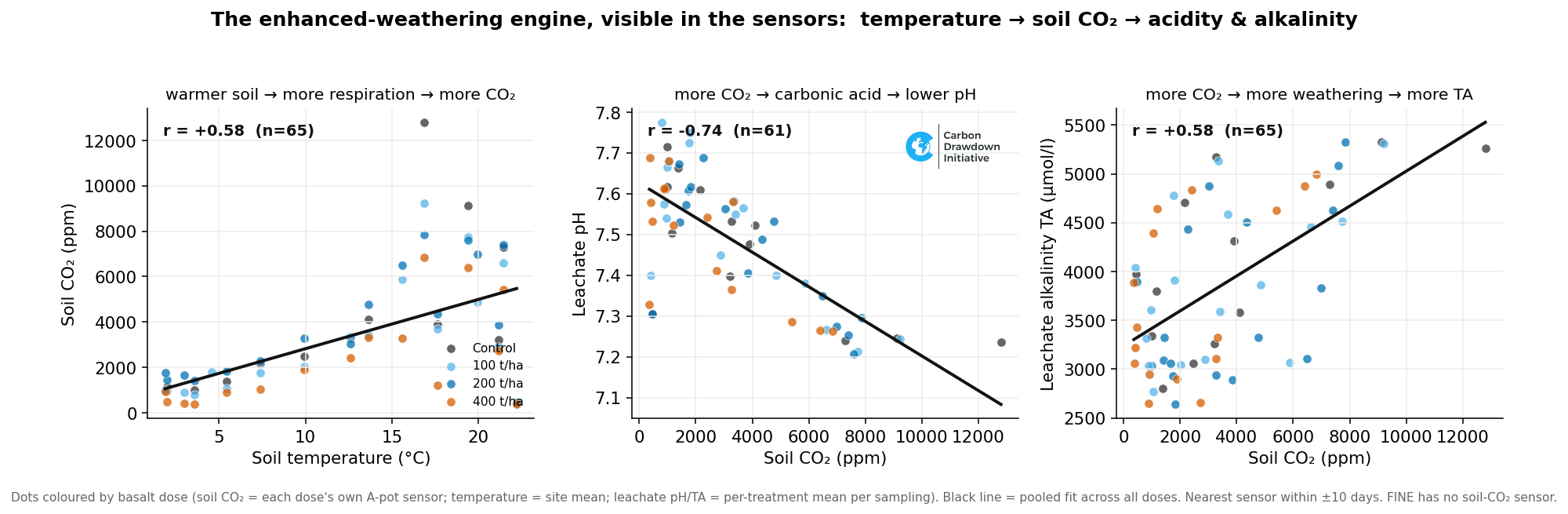
Figure 1: The weathering engine in the sensors — soil temperature vs soil CO₂ (r = +0.58), soil CO₂ vs leachate pH (r = −0.74), and soil CO₂ vs leachate alkalinity (r = +0.58). Dots are coloured by basalt dose (each dose’s own soil-CO₂ sensor; temperature = site mean); the black line is the pooled fit across all doses.
This is the mechanism textbooks describe, caught in the act in a field soil over four years. And it is not a quirk of one treatment: split the same chain out by basalt dose and the signs and rough magnitudes repeat in the control, 100, 200 and 400 t/ha pots alike. The engine is a property of the soil and its seasons, not of the amendment.
With a soil-CO₂ sensor in every pot — four per dose — we can confirm the chain pot by pot as well as in the site average: temperature → soil CO₂ (median per-pot r = +0.78), soil CO₂ → leachate pH (−0.68) and soil CO₂ → leachate TA (+0.36). The same signs, in individual pots. Article 5 takes that per-pot record apart — including the point where the engine stalls: above about 18 °C the summer-dried soil goes quiet and CO₂ falls even as the temperature keeps climbing.
The seasonal wave
Because temperature drives it, the whole system oscillates with the year. Soil CO₂ peaks in summer and collapses in winter, and leachate pH moves in anti-phase — lowest when the soil is breathing hardest.
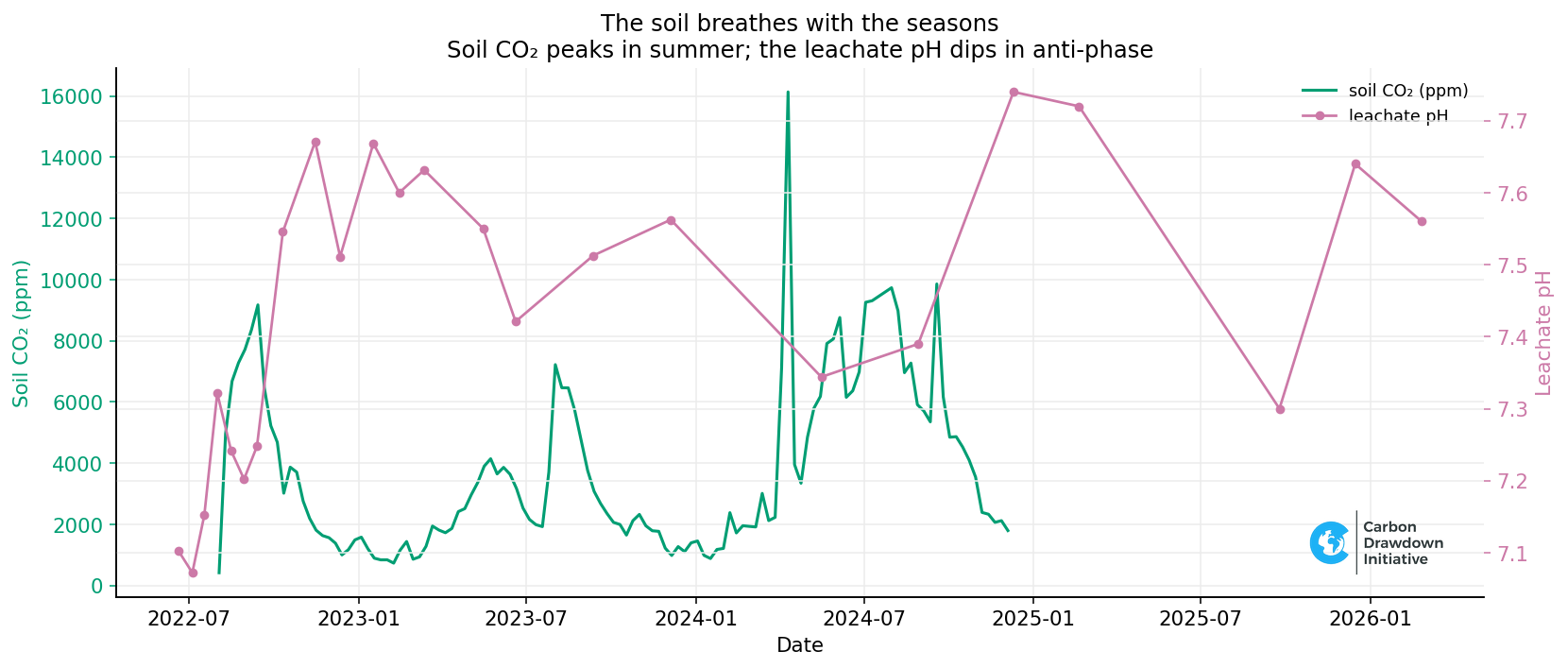
Figure 2: Soil CO₂ (daily sensor, site mean) and leachate pH over ~1,400 days. CO₂ peaks each summer; pH dips in anti-phase.
This seasonality is exactly the kind of structure you lose if you sample only occasionally. A grab sample in July and one in January are not two draws from the same distribution — they are two points on a wave. For MRV that is a double-edged message: the signal is real and repeatable, but its timing matters, and sparse sampling can alias the season into an apparent “trend.”
A complication: temperature and CO₂ travel together
Temperature and soil CO₂ are themselves correlated (r = +0.58) — both ride the same seasonal wave — so we should ask which one actually drives leachate pH. Partial correlations let us hold one constant and test the other:
leachate pH vs soil CO₂, controlling for temperature: r = −0.56 (still strong);
leachate pH vs temperature, controlling for soil CO₂: r = −0.69 (also still strong).
Both survive. Neither is a mirage of the other. The reading that fits the chemistry: CO₂ is the proximate lever on pH, temperature is the seasonal throttle on CO₂, and because they co-vary you see both linked to pH even after mutual control. The link from CO₂ to alkalinity weakens but does not vanish when temperature is held constant (r = +0.58 → +0.44), which is what you would expect if temperature acts through CO₂ rather than around it — leachate TA correlates with soil CO₂ (+0.58) more tightly than with temperature directly (+0.46).
One measurement caveat we keep in view: our soil-CO₂ probes are NDIR sensors, and NDIR readings can drift high when the pore space — and the sensor itself — is humid. Warm summer soil is often also moister at depth, so part of the measured temperature→CO₂ rise could be a humidity artefact rather than extra respiration. We therefore trust the direction of this chain more than its exact slope, and we do not over-read the temperature→CO₂ coefficient.
What this means for MRV
The mechanistic chain is legible in cheap, continuous sensors — and that is the opening for the next article. If soil CO₂ and temperature move leachate pH and alkalinity in a repeatable way, then continuously logged in-situ variables carry information about the weathering flux between the expensive monthly titrations. The soil’s breathing is not noise to be averaged away; it is signal, and it is measurable without a lab.
Next: we put that idea to the test with the one sensor that turns out to track leachate chemistry best — the buried electrical-conductivity probe.
The XXL Lysimeter dataset (2022-2026) series
Intro article — why a 1,400-day, daily-instrumented experiment is worth the wait.
Dose–response — the initial flush (the Birch effect, not weathering), the long convergence, the n = 4 power problem, and the FINE-is-a-different-rock confound.
The soil breathes — how temperature and soil CO₂ drive a seasonal weathering engine visible in the buried sensors.
A buried EC sensor as a continuous MRV proxy — the 60 cm probe tracks leachate chemistry remarkably well (and the 30 cm one does not); the long-term, in-situ extension of our EC-as-alkalinity-proxy work.
What the soil tells us when it breathes — reading four years of buried CO₂ sensors: the soil as a living system of warmth, water and microbes — and why even a sensor in every pot is the weathering engine, not a carbon meter.
Four years of buried sensors — rainfall, ambient CO₂, and the reality that most field sensors die within two to three years.
Data, code & figures: doi.org/10.5281/zenodo.21216439 (CC-BY-4.0) · github.com/dirkpaessler/carbdown_xxl_lysimeter_2022_2026