
How we built our new ERW greenhouse experiment: A methods paper documents our work
On this page 7 sections
Our second greenhouse experiment for enhanced rock weathering (ERW) has 450 pots, 29 soils and 19 feedstocks. Its methods paper is now public as a preprint, and it contains the complete laboratory data of every soil and every feedstock from before the experiment started. The paper is called “A soil–feedstock greenhouse mesocosm matrix for screening carbon dioxide removal via enhanced rock weathering”. It has been on CDRXIV since 30 October 2026, and peer review is underway.
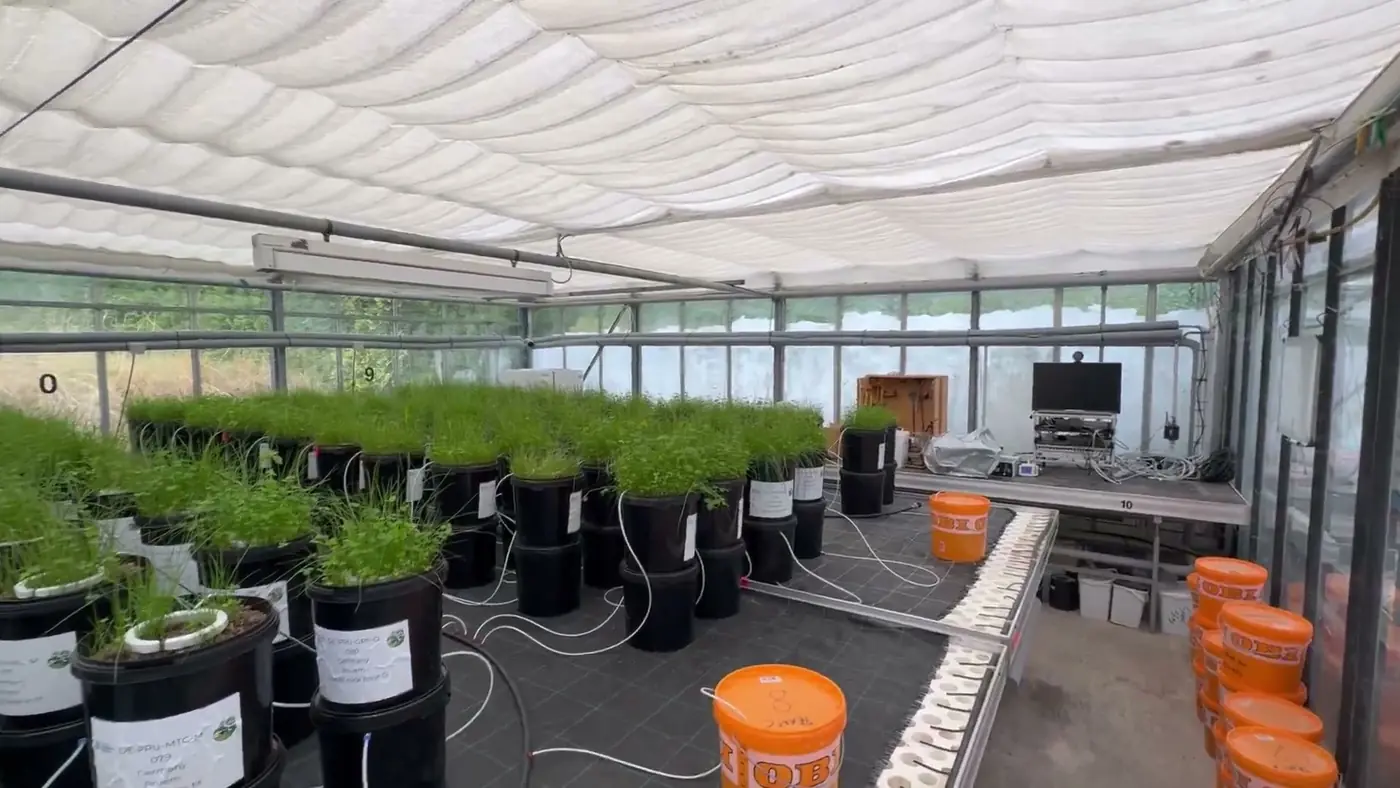
A word of caution: this is a methods paper. It contains no carbon removal results. It describes what we put into the pots, how we measure and why we built the experiment this way. The experiment is still running, and the results will come in later papers.
We publish the design and the “before” data now for two reasons. Anyone who models ERW can work with 29 characterised soils and 19 characterised feedstocks today. And our design is on record before we know what comes out of it.
The first experiment showed that the soil decides
Our first greenhouse experiment, called GH2023 in the paper, ran for two years with 400 pots. What we learned from it was sobering: more than half of the tested combinations showed no significant alkalinity-based carbon dioxide removal (CDR) within two years. Our paper on that experiment showed why this is hard to predict. The same rock dust increased alkalinity export in one soil and decreased it in another, and 10 to 50 times more cations stayed in the soil than left it with the leachate water. Where the removal potential goes on the way is a question of its own.
So the soil decides. But GH2023 could not always tell us which soil property decides. For that we needed more soils and more rocks.
One pot per combination, 450 pots in total
The new experiment, GH2025, goes for breadth. Each soil-feedstock combination gets exactly one pot, and each soil gets three untreated control pots. We announced this decision in March 2025: in GH2023 the differences between combinations were larger than the scatter between replicates of the same combination, so a new combination teaches us more than a fourth copy of an old one. Replicating the whole matrix would have required several thousand pots.
This has a price. We cannot measure the variability within a single treatment directly. Each feedstock runs on many soils, so an odd pot stands out against the pattern of the others. That helps, but it does not replace a replicate.
The 450 pots form four experiments:
- Core: 28 soils, each with 3 controls and the same 7 feedstocks (280 pots).
- Extended series: 8 more feedstocks on 13 of these soils (104 pots).
- Particle size: 5 feedstocks in their original, coarser form next to the milled version, on 6 soils (30 pots).
- Bridge to GH2023: two matched sets of 13 pots on the reference soil LUFA 2.2, one with the old ryegrass and one with the new plant mix (26 pots).
Ten more pots cover special cases, six of them soil-feedstock combinations from ERW field projects of our collaborators.
The soils: pH 3.3 to 7.5, and all from temperate regions
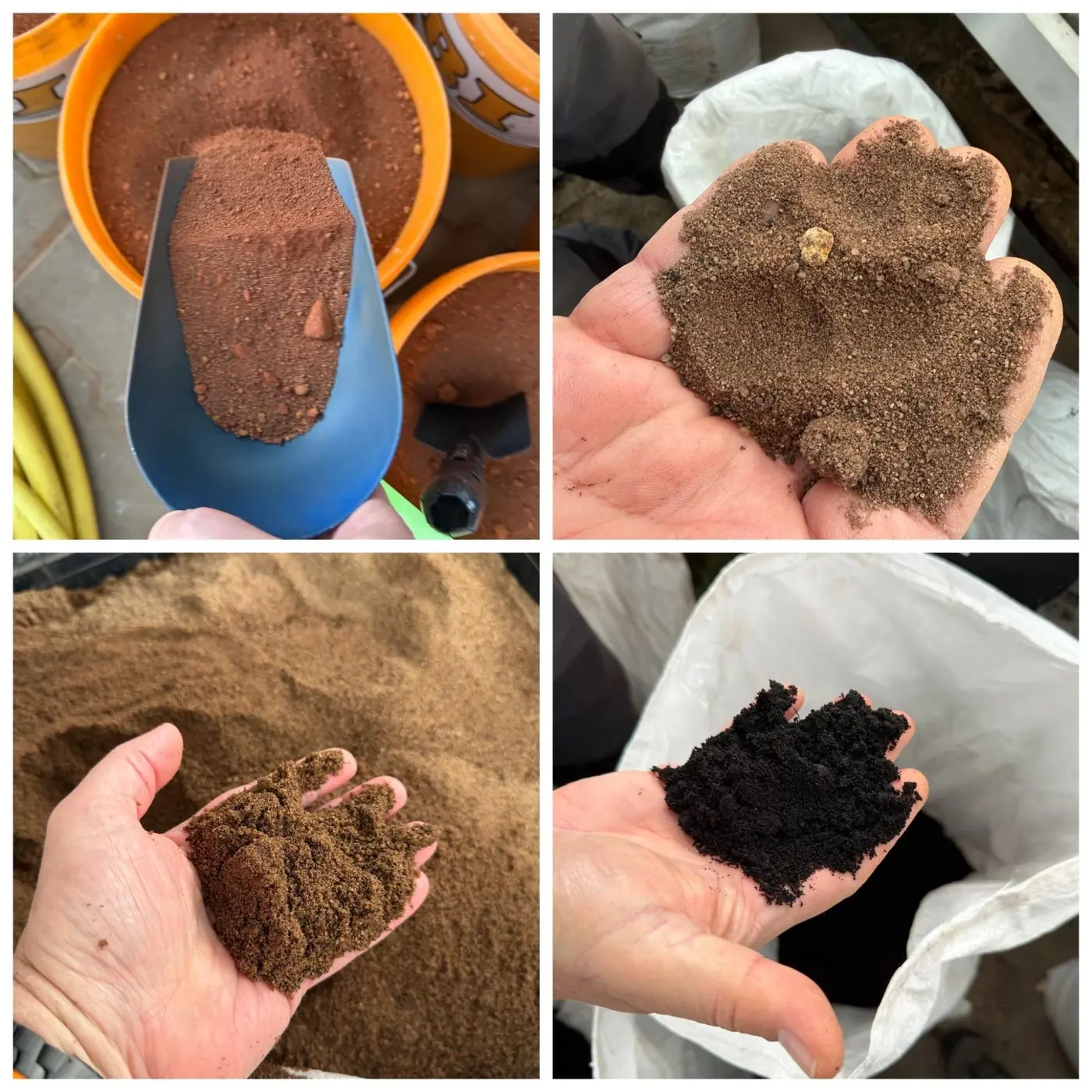
The 29 soils are natural soils, farm soils and soils we engineered ourselves. They span pH 3.34 to 7.50, an effective cation exchange capacity of 1.1 to 25.4 cmol/kg, clay contents from 5% to 37% and organic carbon from 0.06% to 4.5%. Three soils lie below pH 4, more acidic than typical farmland. We included them on purpose as acidic end-members.
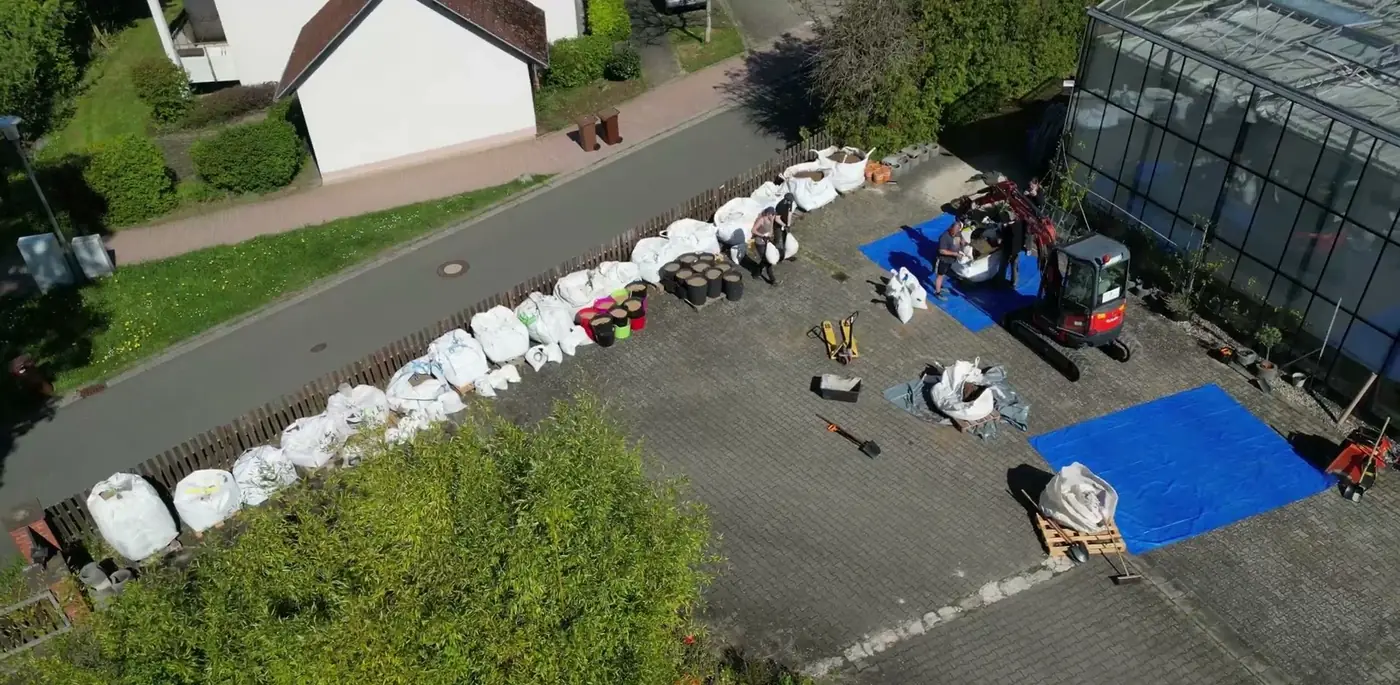
Some of the extremes: Wolfland is the most acidic and the sandiest soil (pH 3.34, 92% sand). Fabrikfeld is calcareous, calcite is its main mineral. Pruem consists of 44% 2:1 layer silicates, the clay minerals that hold on to cations. Marsianer is a strongly weathered soil with iron oxides, 86% quartz and almost no exchange capacity (1.1 cmol/kg).
Where the soils we could get left gaps, we mixed our own: we blended two sandy soils with an organic-rich material we call “Black Bavarian Swamp” to raise their organic carbon.
The soil hunt also produced a failure. We wanted tropical soils, and we did not manage to import them. We wrote about that in August 2025. The soils in the paper most closely resemble Cambisols and Luvisols, which cover about 15% of the global land area and more than 40% of the EU. Highly weathered tropical soils, Vertisols, Chernozems, volcanic Andosols and the soils of arid regions are missing. Whatever GH2025 finds will apply to temperate soils first.
For every soil the paper reports pH, electrical conductivity, exchange capacity and exchangeable cations, texture, organic and inorganic carbon, nitrogen, bulk chemistry and mineralogy. We measured pH and conductivity in our own lab. The soil laboratory of the Institute of Geography at FAU Erlangen-Nürnberg determined exchange capacity and texture, Marcus Schiedung at the Thünen Institute ran the carbon analyses, and Qmineral in Leuven did the chemistry and mineralogy.
The feedstocks: seven categories, from steel slag to glacial rock flour
The 19 feedstocks fall into seven categories, ordered by how fast we expect them to dissolve:
- one steel slag,
- two limestones,
- three carbonate-silicate mixes,
- four calcium and magnesium silicates (two synthetic materials and two natural skarns),
- two olivine-rich peridotites,
- five mafic volcanic rocks: one basanite, one basalt and three nephelinites,
- two glacial rock flours.
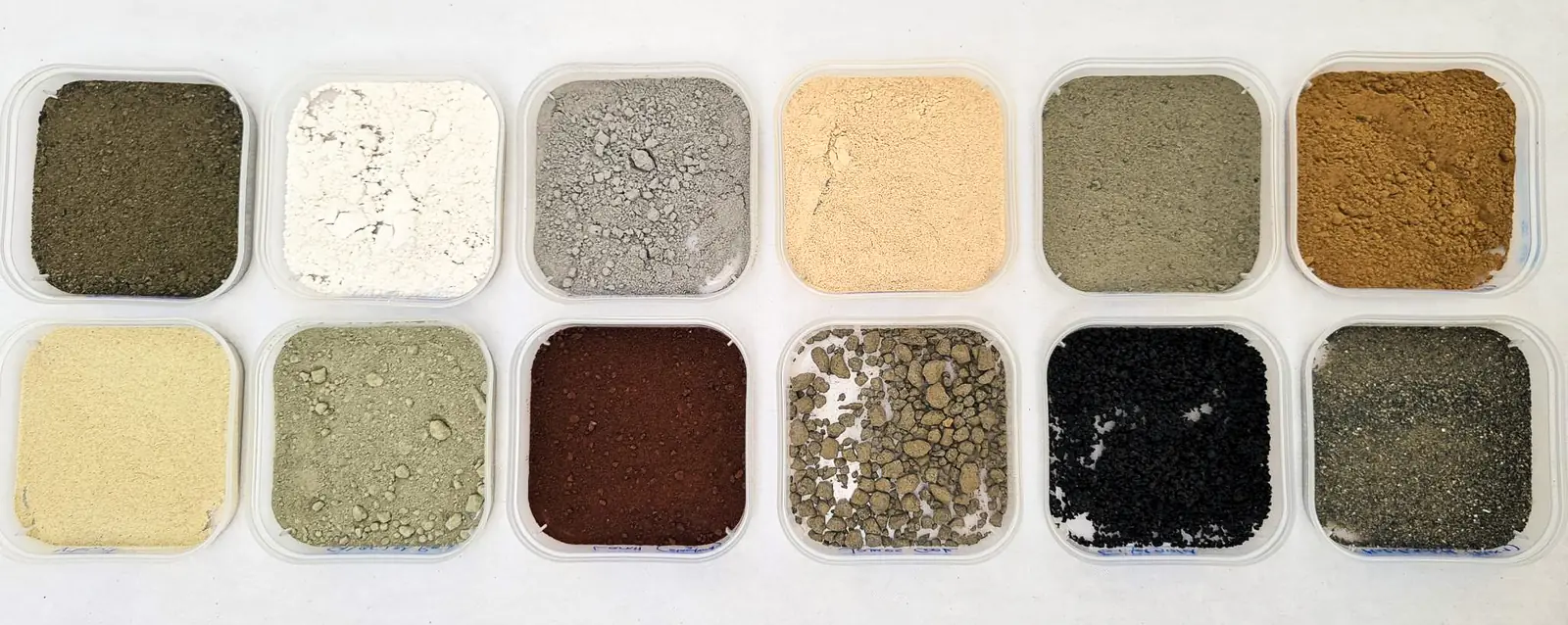
Their theoretical maximum CDR potential ranges from 253 to 1,244 kg CO₂ per tonne. That number overstates carbonates: when limestone dissolves, half of the carbon in the resulting bicarbonate comes from the rock itself. The paper therefore reports a second, carbonate-corrected value. For one of the limestones it drops from 874 to 431 kg CO₂ per tonne. For a carbonate-free peridotite it stays at 1,037.
Mineralogy is one half of reactivity, grain size and surface area are the other, as our data from GH2023 showed. The feedstocks span median particle sizes (d50) from 1.6 to 213 µm and BET surface areas from 0.1 to 19.2 m²/g. The two glacial rock flours have a d50 of about 2 µm without any milling, finer than anything that came out of the mill (5 to 23 µm). What such fine material does to a sandy soil we saw early in this experiment.
One feedstock is called “Angryd Frankenstein”. It is the ultrafine dust that the filter of the mill collected while the other feedstocks were milled, a mix of everything. We put it into the pots as a feedstock of its own.
What we changed in the pots
The pot is the one from GH2023: two stacked 10-litre buckets, the upper one with soil, rock dust and plants, the lower one collecting the leachate water. Here is how we build them, and here is a video of the rebuild. Three things changed:
- The drainage between the two buckets is better and clogs less.
- The rock dust, equivalent to 40 t/ha, is mixed through the full 20 cm of soil. In GH2023 it sat only in the upper 15 cm.
- A mix of two grasses and a microclover replaces the ryegrass monoculture. In GH2023 ryegrass alone established poorly on some soils, and re-seeding disturbed the leachate chemistry.
The third change could alter the results by itself. That is what the bridge experiment is for: same soil, same feedstocks, old plants against new plants.
The rest is as before, and far from field conditions in Germany: a median air temperature of 21 to 22 °C and 2,000 to 4,000 mm of irrigation per year. Where on Earth such a climate exists is a story of its own. Every pot got 20 earthworms. We use no synthetic pesticides, because they would add ions to the leachate. Beneficial insects do the job, supported by flower strips in the greenhouse. Against powdery mildew we spray diluted raw milk, and we log every application per pot, so that the calcium, magnesium, sodium and potassium in the milk are not counted as weathering.
What we measure, and where we draw the line
Every six to eight weeks we collect the leachate of each pot and measure volume, pH, electrical conductivity, dissolved oxygen, temperature and total alkalinity, and we take a sample for dissolved inorganic carbon. In selected rounds we add cations and anions. Earlier posts explain how we turn alkalinity into a CDR effect, why alkalinity is not the same as bicarbonate and how far conductivity can stand in for titrations.
The system boundary is the bottom of the pot. Alkalinity that leaves the pot counts as carbon removal at this boundary. What happens to it afterwards in groundwater, rivers and the ocean is outside this experiment.
After about two years we will dismantle the pots and analyse the soils again, to see where the cations went that did not leave with the water. Most published ERW pot trials ran for weeks to months. One detail matters for the comparison: each of the 450 pots has its own archived soil sample from the day it was filled. We will compare every pot with its own “before”, not with an average.
The data are open, and the pots are still running
All tables of the paper are on GitHub and archived at Zenodo under a CC BY 4.0 licence: soil properties, exchangeable cations, chemistry and mineralogy of soils and feedstocks, particle size distributions, surface areas, the analytical methods and the full design matrix that says which rock sits in which soil.
The plan for the final dataset is machine learning. Can we predict from routine soil and rock analyses which combinations export alkalinity? We will test this on soils, feedstocks and combinations that the model has not seen. We also want to know whether cheap measurements such as conductivity and drainage volume can replace part of the expensive ones.
The paper was written by Dirk Paessler, Jens S. Hammes, Ingrid Smet, Anna A. Stoeckel and Ralf Steffens (Carbon Drawdown Initiative), Jens Hartmann (Universität Hamburg) and Melissa J. Murphy (Mel Murphy Geochemistry).
If you model ERW or plan a deployment on temperate soils, take the tables and tell us which parameter you are missing. The baseline samples of all 450 pots are in our archive, so a missing “before” measurement can still be made.