The EU is about to become the world's largest buyer of permanent carbon removal, but the first draft of the purchase order lists only two products. That is not a good choice for the EU.
The Commission's ETS proposal of July 2026 sets aside 250 million allowances for 2031 to 2040 and spends their revenue on bio-CCS and direct air capture with storage (BECCS and DACCS). Biochar, enhanced weathering, mineralisation, ocean removal and biomass burial are absent. We think this would be the wrong decision for the EU, not because we doubt those two pathways, but because our data say it concentrates the programme in 13 of the 27 member states and backs the two pathways where Europe's companies are at best level with the United States. A programme that wants to kick off a proper European removal industry should buy from every pathway the EU itself certifies as permanent.
In July 2026 the Commission proposed its ETS revision (COM(2026) 616). The new Article 9c spends the revenue of those allowances on "domestic permanent carbon removal units generated by BioCCS and DACCS activities" certified under the Carbon Removal Certification Framework (CRCF).
What we think is illogical: the CRCF already certifies biochar. Its first methodologies for permanent removals (Delegated Regulation (EU) 2026/285) cover DACCS, bio-CCS AND biochar, and the Council's working text of 30 October says mineralisation and enhanced rock weathering come next.
We welcome rapporteur Peter Liese's draft report that admits biochar from 2029, unfortunately capped at 20 %; six amendments from EPP and Renew members go the last step and admit any activity the CRCF certifies as a permanent removal. That is the whole choice: a list written into the Directive in 2026, or a gate that the EU's own certification framework opens pathway by pathway as the science matures (which it will do quickly).
Two pathways reach 13 member states. The pathways left out reach 16, and the research base reaches all 27.
Our public CDR directory lists 913 carbon removal companies worldwide, 246 of them in the EU27, 200 of which name a removal pathway (the other 46 are enabling technology). 56 of those, in 13 member states, would qualify under the Commission's list, and 44 of the 56 sit in five countries: Sweden 13, the Netherlands 10, Germany 7, Denmark 7, France 7.
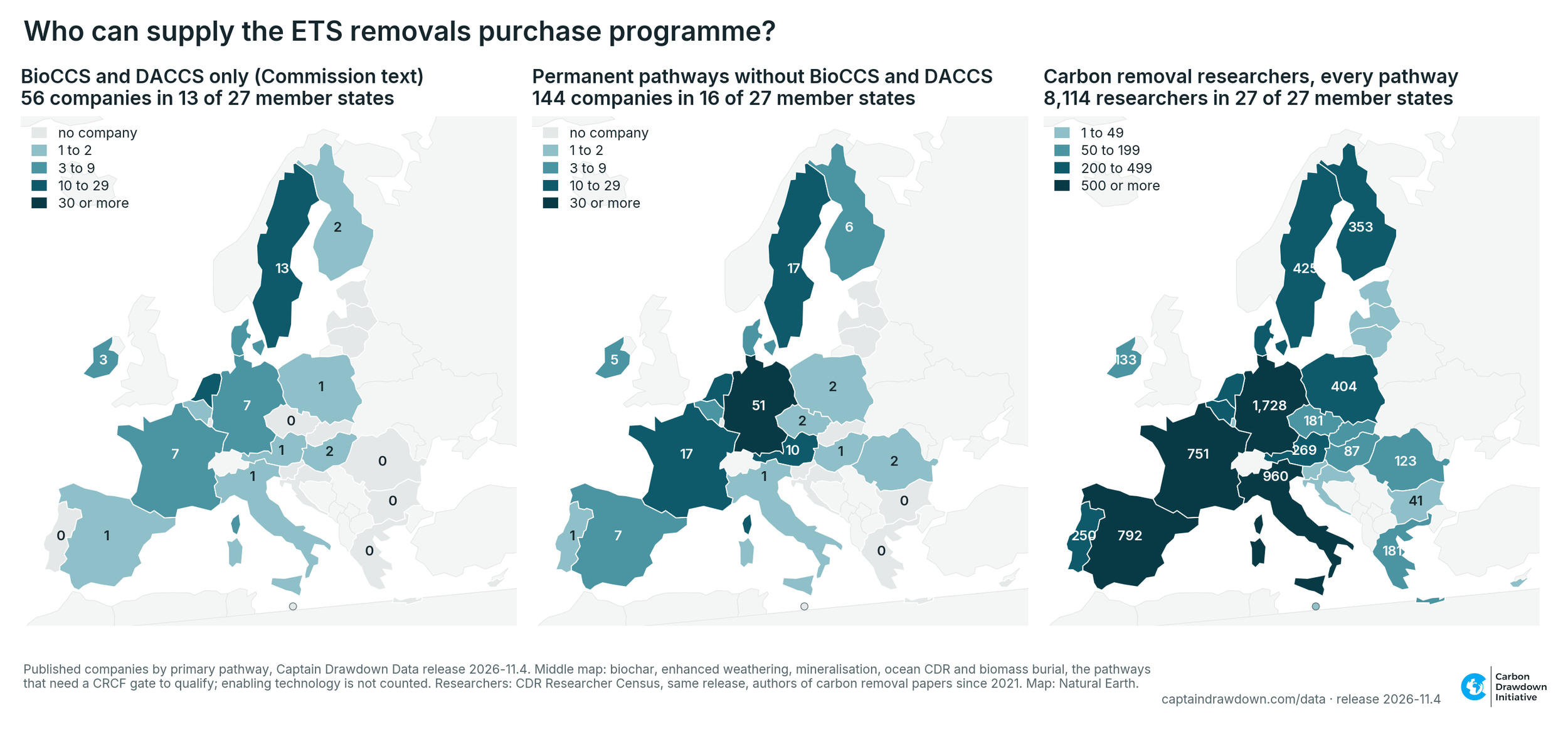
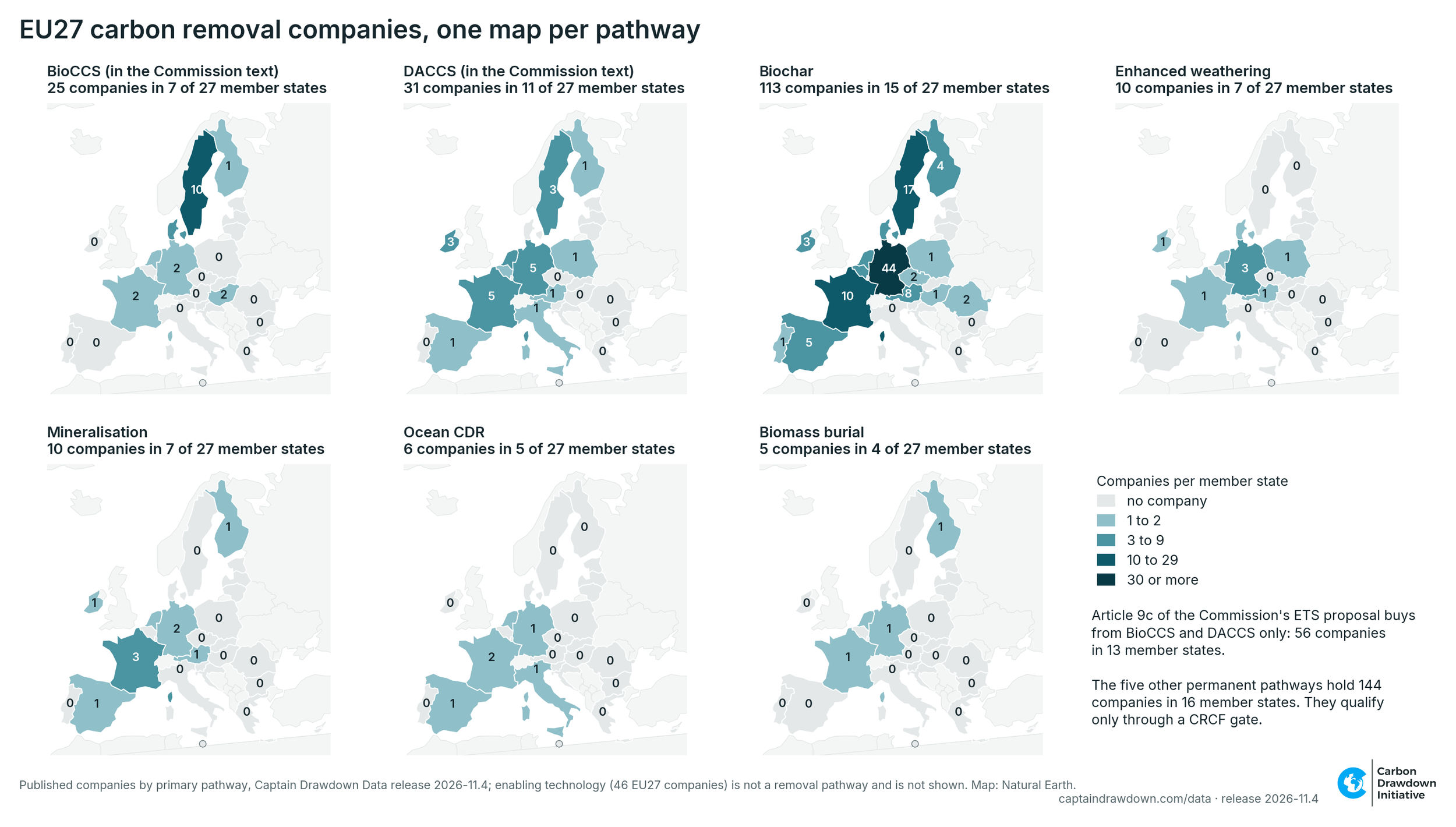
The five pathways left out draw a different map: 144 companies in 16 member states, the first eligible suppliers in Czechia, Portugal and Romania, and most of the companies in Austria (10 of 11), Spain (7 of 8), Ireland (5 of 8) and Finland (6 of 8). Biochar alone is 113 companies in 15 states, 44 of them in Germany.
Eleven member states have no published removal company at all, and every one of them has carbon removal researchers, 512 between them out of 8,114 in the EU27; Italy has 960 researchers and four companies. The allowances come out of a cap that every installation in every member state pays into, and as drafted the revenue lands in Stockholm, Copenhagen and Rotterdam. That is an argument for letting the other sixteen states in, not against the Nordic projects.
The list backs the two pathways where Europe's companies are weakest, and skips the ones where they are strongest
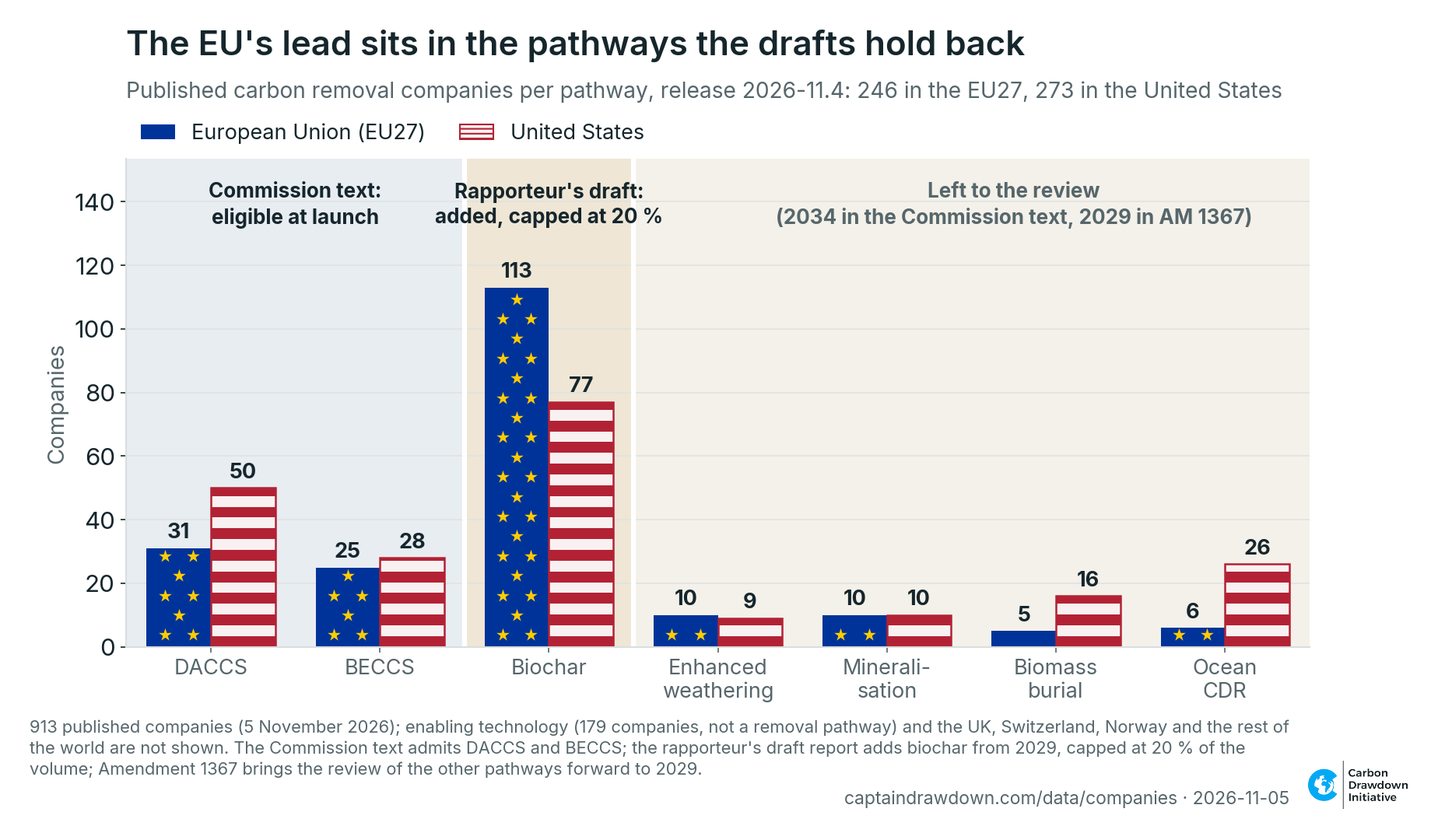
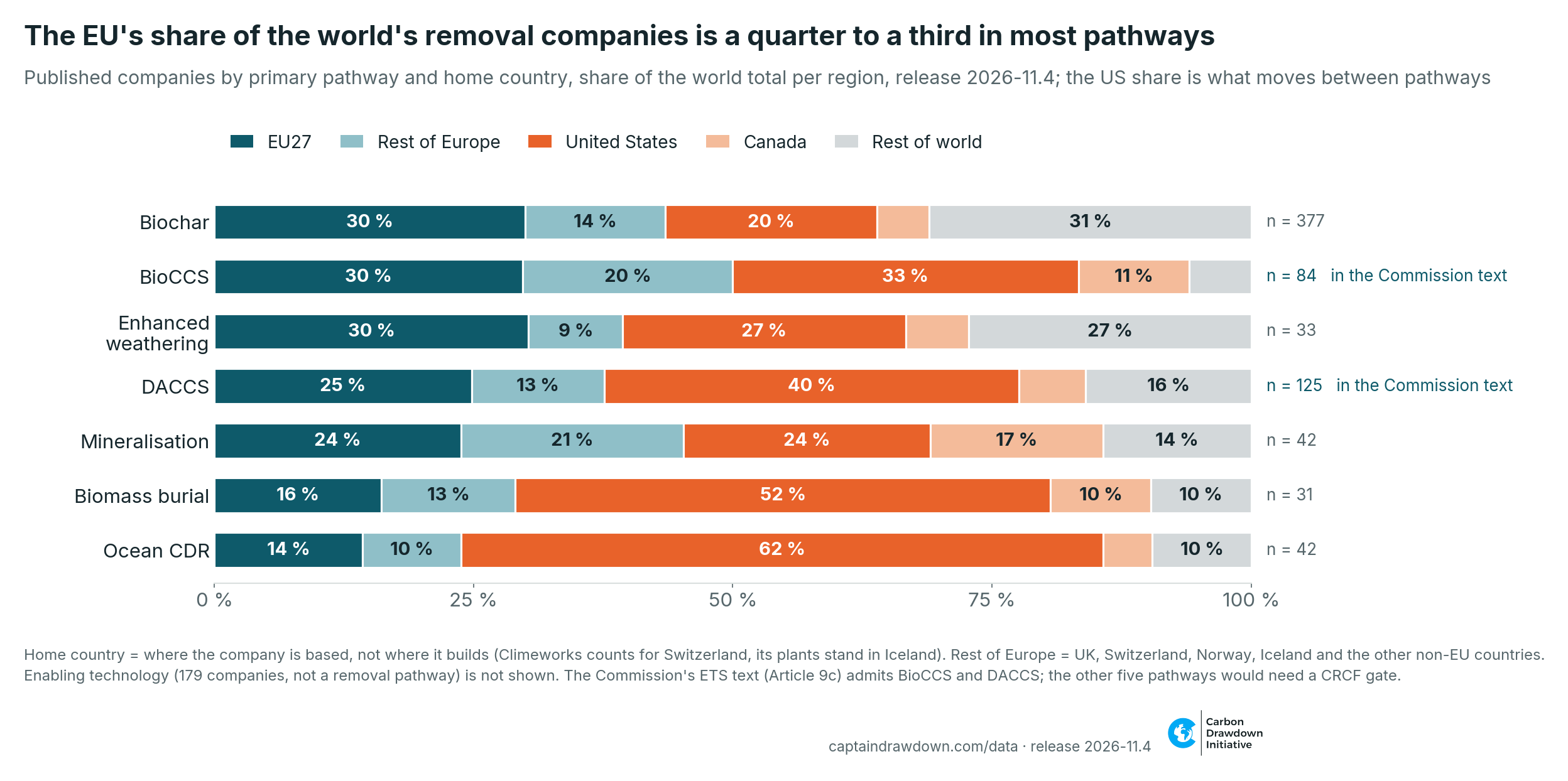
Based on our data, in DACCS the EU27 has 31 companies against 50 in the United States, in bio-CCS 25 against 28. In biochar it is 113 against 77. In the two pathways the Commission chose, the EU27 has 56 companies and the United States 78. In the five it left out, the EU27 has 144 and the United States 138. Our researcher census says the same, with the EU27 ahead in every pathway it tracks except DAC.
Companies are not tonnes. DACCS has delivered only 1,186 tonnes worldwide since 2023, 81 % of them by Climeworks in Iceland; inside the EU27 it is pilots. No European bio-CCS plant has delivered a tonne yet, Ørsted's start has slipped to 2027 and Stockholm Exergi's is 2028, while US ethanol plants already deliver: 364,000 tonnes certified by Puro in 2025. Europe's 205 biochar plants removed about 170,000 tonnes of CO2 last year.
How does one explain the Commission's focus on DACCS and BECCS (with minimal or no delivered tonnes in Europe) over the pathways that have been delivering six-digit tonnages for years? In our blog post The Early CDR Certificate Is the Product we have already made the point that getting a CDR company to its first certified tonnes is the first goal to achieve. The EU must support its startups in this phase!
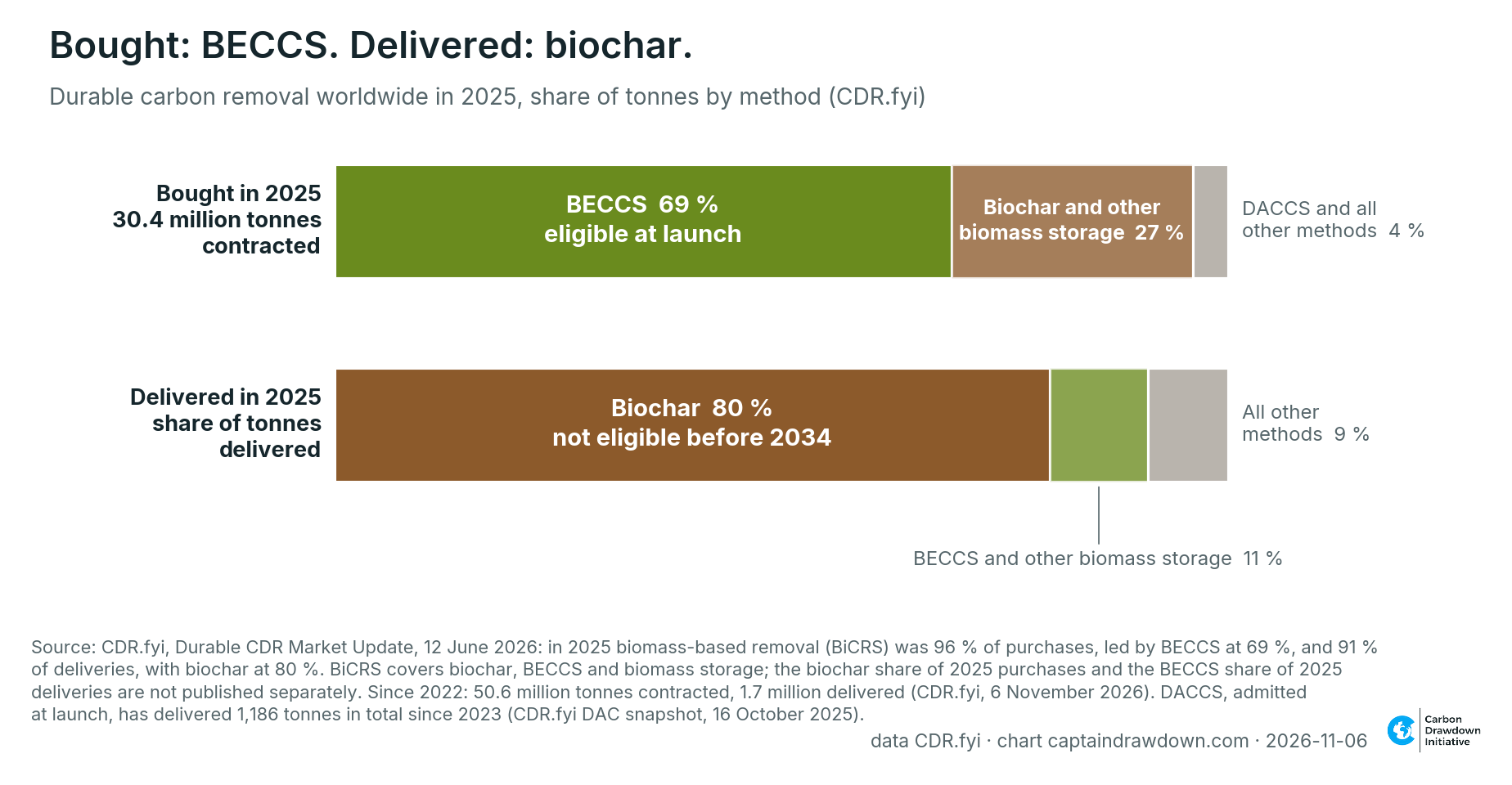
The current situation is strange: most "bought" tonnes are BECCS, but the "delivered" tonnes are 80 % biochar. In practice, delivered CDR in 2025 is biochar. And the EU wants to run its removal programme without it?
Permanence is the certification framework's job, not the Directive's
Yes, monitoring, reporting and verification (MRV) is not perfect yet for a number of pathways: for some methods we are still working out how to measure the tonnes of CO2 actually captured and stored, and for how long. But this is clearly a technical/scientific problem for the certification process, not a regulatory problem. The CRCF already does this job: a pathway enters only through a methodology adopted as a delegated act, with monitoring, liability and reversal rules attached, and Parliament and the Council can veto each act.
What we ask for, and what we have at stake
In Article 9c(1), Parliament should replace "generated by BioCCS and DACCS activities under Regulation (EU) 2024/3012" with "generated by activities certified as permanent carbon removals under Regulation (EU) 2024/3012". That is the wording of Amendments 1284, 1285, 1286, 1288, 1293 and 1300, and the first of the two options the five European removal associations put to the negotiators.
The ENVI committee votes on 1 December; if you run or work for a removal company in the EU, your MEP sits on that committee or knows someone who does.
For transparency, so nobody has to guess our interest: the Carbon Drawdown Initiative is funded by our family foundation, we are super-early investors in more than 30 removal companies and we run enhanced weathering research of our own; our CEO Dirk Paessler is co-founder and vice president of the Negative Emissions Platform; this post is the Initiative's view, not the Platform's. A wider gate in the ETS could help companies we hold shares in, and 144 other EU companies in 16 member states.
All numbers come from the Captain Drawdown data release 2026-11.4, open at captaindrawdown.com/data and on GitHub.